
July 13, 2026
How to Convince Your Landlord to Allow Airbnb
By Shaun Ghavami

You convince a landlord to allow Airbnb by removing their risk, not by selling them on Airbnb. A landlord does not care that short-term rentals are popular. They care about their property, their mortgage, their insurance, and their neighbors. So the pitch that works turns each of those worries into a promise: rent paid on time every month, professional cleaning and upkeep, the right insurance in place, and a written agreement that protects them. Before any of that, two things have to be true. Your lease has to allow it, and your city has to permit short-term rentals at that address.
I have signed and managed agreements on both sides of this table. I run a Vancouver management company with a portfolio worth more than $100 million in homes we operate but do not own, and I have sat across from plenty of cautious owners. The ones who say yes are not talked into it. They are shown a plan that makes them more money with less hassle and less risk than a normal tenant. Here is how to build that plan.
First, the truth: your landlord can legally say no
Start here so you do not waste anyone's time. A standard residential lease often bars subletting or short-term rentals unless the landlord agrees in writing. As the definition of a sublease makes plain, a tenant can hand use of the unit to a third party only when the lease allows it, and a sub-let to a stranger usually is not permitted without the landlord's permission. Airbnb says the same thing to its own hosts: its Airbnb Help Center tells hosts to read the lease, check with the landlord, and review any HOA or co-op rules before listing.
The second gate is your city. Short-term rental rules are local, not federal, and short-term rentals are regulated block by block. Some cities require a permit, cap the number of nights, or restrict rentals to owner-occupied homes. Confirm the law for your exact address before you pitch, and read my note on short-term rental laws for how to check. If the lease or the law says no and cannot be changed, respect it. There is a better path further down for that case.
Understand what your landlord is actually worried about
You cannot answer an objection you have not named. Almost every landlord hesitation comes down to a short list.
None of these are about Airbnb itself. They are about risk and hassle. Your entire pitch is proof that you remove both.
The win-win pitch: what to offer
Once you know the worries, you answer them with concrete offers. These are the levers that move a cautious owner.
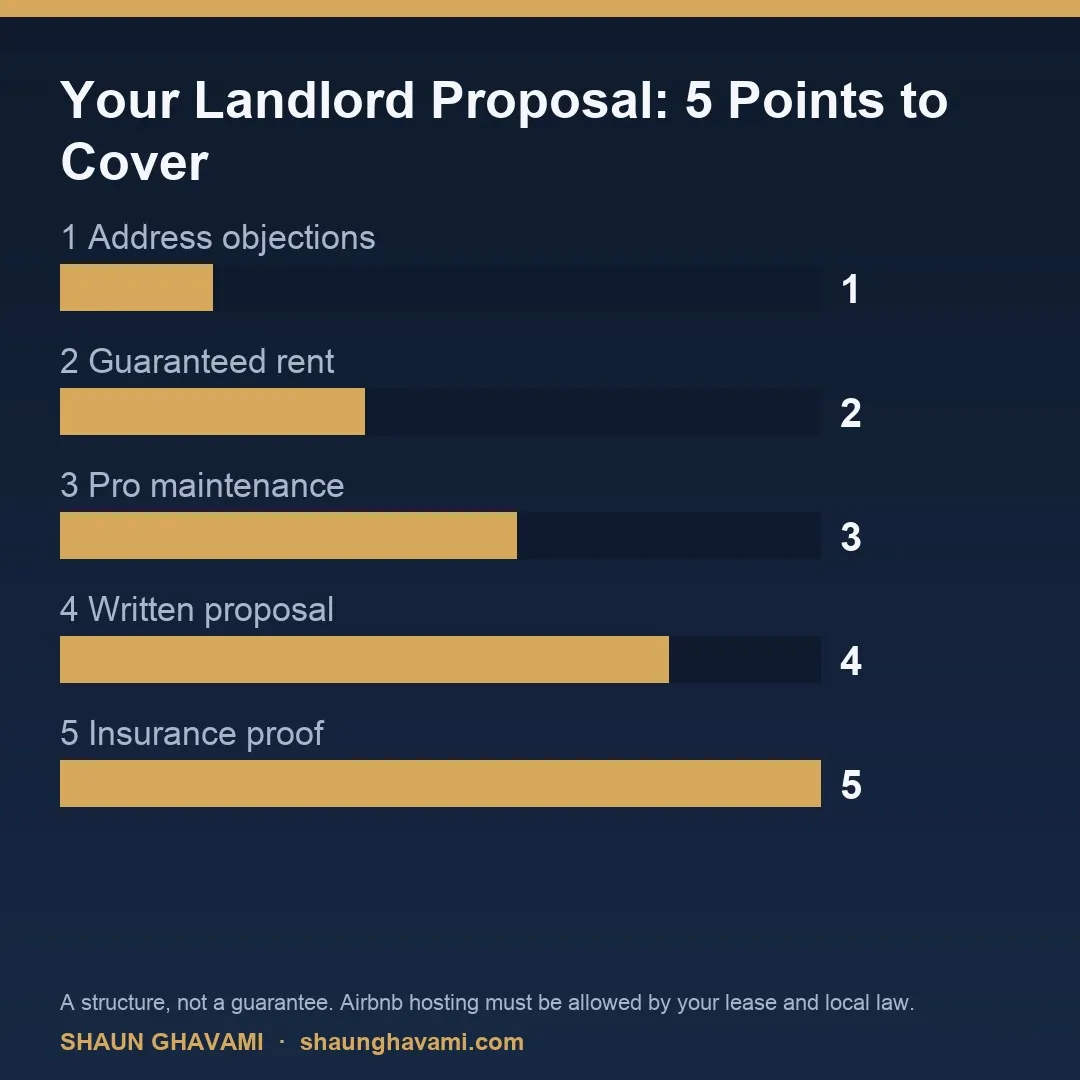
Put it in a written proposal
A verbal ask is easy to refuse. A written proposal shows you are serious and gives the owner something to review. Keep it to one or two pages and cover these points.
Want my landlord proposal template and script? I walk through the whole pitch, the paperwork, and the co-hosting fallback inside 10XBNB. Get the free Airbnb co-hosting training
Lease and sublet clauses to request
If the owner is open to it, get the permission into the paperwork. Do not rely on a friendly text message. Ask for these in writing:
This paperwork is the difference between a business and a risk. It protects you as much as the owner.
Insurance and liability, in plain terms
I am not going to name a specific policy, because coverage depends on your country, your city, and the owner's insurer. Here is the general shape of it. A landlord's standard policy is written for a long-term tenant, not for paying guests, so short-term rental use can fall outside it. Tell the owner to check with their own insurer and ask about a short-term rental or home-sharing endorsement. On your side, carry your own liability coverage for the operation. Airbnb also provides host protections on bookings made through the platform, but treat those as a backstop, not a replacement for real insurance. The reassurance that lands with owners is simple: you have thought about this, you are covered, and you are asking them to confirm their side too.
A simple talking-points structure
When you sit down with the owner, keep the conversation in this order. It answers their worries before they have to raise them.
Confidence and paperwork win these conversations. Pressure does not.
Mistakes that get you a no
I have watched good deals fall apart over avoidable errors. Steer clear of these.
If your landlord says no
Some owners will decline, and some leases and city rules leave no room to change their mind. That is not the end of your hosting plan. You can build Airbnb income without renting or owning anything by co-hosting for owners who already allow short-term rentals. It sidesteps the landlord problem entirely, because the owner has already said yes. I lay out the whole approach in how to start an Airbnb without owning property, and I compare it head to head with renting a unit in co-listing versus rental arbitrage. For the full business picture, start with my guide to starting an Airbnb business.
If you are new to the whole concept, start with what a short term rental actually is, and the wider short term rental guide for beginners covers everything else you need once the lease question is settled.
Frequently asked questions
Can my landlord stop me from listing on Airbnb?Yes. A standard lease often bars subletting or short-term rentals without the landlord's written permission, and your city may require a permit or restrict rentals to owner-occupied homes. You need both the lease and the local law on your side before you host a single night.
How do I ask my landlord to allow Airbnb?Lead with their benefit, not yours. Offer guaranteed rent or a premium above market, professional cleaning and maintenance, guest screening, the right insurance, and a written agreement that protects them. Put it in a short written proposal so they have something concrete to review.
What should I put in a written Airbnb proposal to my landlord?Cover the ask, the rent or revenue split and when it is paid, your cleaning and maintenance plan, the insurance each side will carry, your house rules and guest limits, and how either party can end the arrangement. Keep it to one or two pages.
Should the landlord change their insurance for Airbnb?They should check with their own insurer. A standard landlord policy is written for a long-term tenant, so short-term rental use can fall outside it. Ask the owner about a short-term rental or home-sharing endorsement, carry your own liability coverage, and treat Airbnb's host protections as a backstop rather than a full policy.
What if my landlord says no to Airbnb?Respect the lease and the local law. Then look at co-hosting instead, where you run listings for owners who already permit short-term rentals and take an agreed share of the revenue. It removes the landlord obstacle because the owner has already agreed to host.
Do I need my city's permission too, not just my landlord's?Yes. Short-term rental rules are set locally, not nationally, and they vary widely by city. Some places require a permit, cap the nights per year, or restrict rentals to owner-occupied homes. Confirm the rules for your exact address with the local government before you pitch your landlord.
Want the co-hosting playbook? Shaun teaches this system inside 10XBNB. Get the free Airbnb co-hosting training

.png)

Be Part of our Community.
Let’s transform properties into powerhouses.
