
July 13, 2026
Short-Term Rental Laws: What Every Airbnb Host Must Check
By Shaun Ghavami

Short-term rental laws in the United States are local, not federal. There is no single national rulebook for Airbnb. Your city and county decide whether you can host, and they set the registration, permits, taxes, and limits you follow. Before you list, check six areas: registration or a license, zoning and primary-residence rules, occupancy and night caps, lodging taxes, your HOA or lease, and safety codes. The rules change from one address to the next, so confirm yours on your city's official website. What follows is a plain-English overview from my years of hosting and managing rentals. Treat it as a starting point for your own research, not legal advice.
In my business I have hosted more than 3,000 guests and helped manage a portfolio worth over $100 million (managed, not owned). The fastest way I have watched new hosts get burned is skipping the legal step. A listing that goes live without the right permit can get pulled, fined, or blocked by the platform. Ten minutes of checking first saves months of trouble later.
Are short-term rental laws federal or local?
Local. In the US, short-term rentals are regulated mostly at the city and county level. Common local rules include business licenses, lodging or hotel taxes, limits on how many nights a space can be rented, requirements that the host live in the property, and compliance with building and zoning standards. Homeowner associations often add their own limits on top of all that.
Because the rules are local, two hosts in the same state can face completely different requirements. A beach town might welcome rentals and simply ask for a permit. A dense city might cap the number of nights, require you to live on site, or ban whole-home rentals in certain zones. This is why I never assume. I check the exact address every time.
If you are still deciding whether hosting fits your goals, my guide on what a short-term rental is covers the basics before you spend a dollar.
The 6 categories of short-term rental laws to check
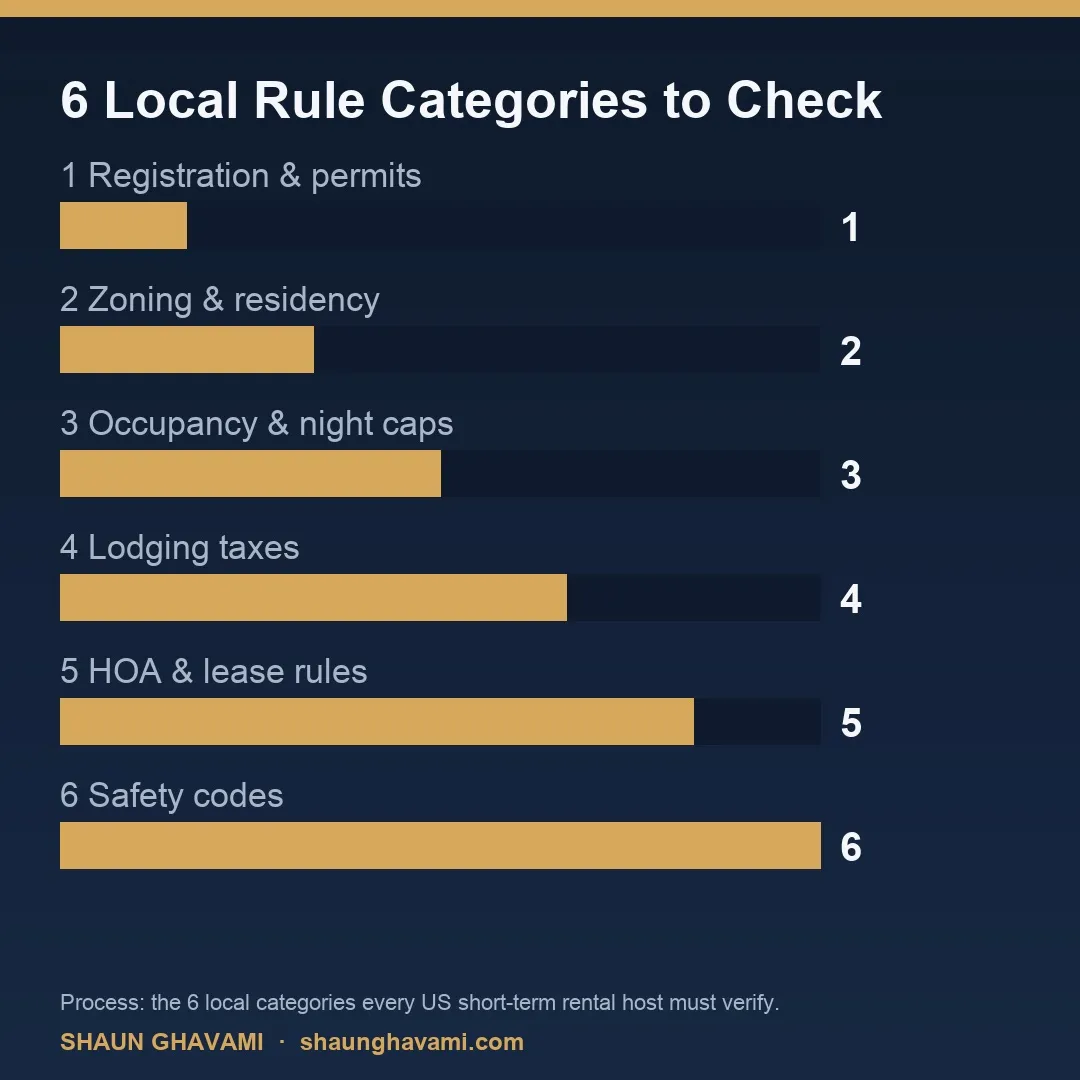
Almost every local rule falls into one of six buckets. Work through them in order for any property you are considering.
1. Registration, permits, and licenses
Many cities require you to register your rental, buy a license, or apply for a permit before you accept a single booking. Some also make you display the license number on your listing so the city can match it to a real, approved property. Skip this and the booking platform can be forced to remove you.
2. Zoning and primary-residence rules
Zoning decides where rentals are even allowed. Some neighborhoods permit them, others do not. A frequent restriction is the primary-residence rule: you can only rent the home you actually live in, and sometimes only while you are present or for part of the year. If you plan to host a property that is not your home, confirm the zone allows it first.
3. Occupancy limits and night caps
Cities often cap how many guests can stay and how many nights per year you can rent. A night cap is common in tourist-heavy areas trying to protect long-term housing. If your business math assumes 300 booked nights and the city caps you at 90, that changes the whole plan.
4. Lodging and occupancy taxes
Short-term stays usually trigger a lodging tax, sometimes called an occupancy or hotel tax, collected from the guest and passed to the city, county, or state. In some places Airbnb collects and remits this for you. In others you register and file it yourself. Separate from local lodging tax, your rental income is generally reportable on your federal return.
There is one well-known federal exception. Under the IRS minimal rental use rule, IRS Topic No. 415 states that if you use a home as a residence and rent it for fewer than 15 days in the year, you do not report the rental income and you do not deduct rental expenses. That rule is about federal income tax only. It does not exempt you from local permits or lodging taxes. For the day-to-day money side, see my breakdown of how to price your Airbnb.
5. HOA rules and your lease
Even where the city says yes, a homeowner association or a landlord can say no. HOA bylaws often restrict or ban short stays, and standard leases usually forbid subletting or hosting without written permission. Read the documents and get any approval in writing before you list. Breaking a lease or HOA rule can cost you the property, not just a fine.
6. Safety codes and inspections
Some cities tie your permit to safety requirements: smoke and carbon monoxide detectors, fire extinguishers, exit signage, occupancy postings, or a passed inspection. These protect your guests and your license, and they are good practice even where the city never checks. Clear house rules help here too, and my post on writing Airbnb house rules shows how to set guest expectations from the first message.
Two real examples of how much the rules differ
Here are two US cities I verified directly on their official sites. Notice how different the requirements are, and treat this only as a snapshot. Local rules change, so always confirm the current version yourself.
CityWhat the city requires (verified July 2026)Austin, TexasDefines a short-term rental as a residence rented for under 30 consecutive days. All STR owners and operators must be licensed through the city.Minneapolis, MinnesotaRequires a short-term rental license for any stay of 30 days or less, and the license ID must appear on the platform listing. An owner may hold one license beyond a primary residence, with occupancy limits.
Sources: City of Austin and City of Minneapolis. Fees, caps, and definitions can change, so read the current page for your own city before you list.
Want to host without the legal headache of owning? Shaun teaches the co-hosting model inside 10XBNB, where the owner keeps the permit and you run the operation. Get the free Airbnb co-hosting training
How to find your city's short-term rental rules, step by step
Write down what you find for each address. If a property fails on zoning or a lease ban, move on before you invest in furniture or photos.
You can host without holding the permit yourself
Here is the part most new hosts miss. You do not have to own or even rent a property to earn from short-term rentals. I built much of my business by co-hosting for owners who already had the permit, the license, and the property in their name. The owner stays the licensed party. I run the operation: pricing, guest messaging, cleaning, and reviews. In exchange the co-host earns a share of each booking, set by a written agreement.
This model lowers your legal exposure at the start because the registered owner holds the compliance side. You still learn the rules, but you are not the one filing for every permit. If that path fits you, start with how to become an Airbnb co-host and lock the terms into an Airbnb co-hosting agreement so pay, duties, and responsibility are clear on paper.
If you do plan to own and operate your own place, my guide on becoming an Airbnb owner walks through the setup, and the full how to start an Airbnb business playbook ties the legal, pricing, and operations pieces together.
What happens if you skip the rules
The downside is not theoretical. Cities that require registration increasingly ask the platforms to remove listings that lack a valid license number, so your calendar can go dark overnight. Operating without a permit can bring fines that stack up day after day, and skipping lodging tax can leave you owing back taxes with penalties on top. An HOA or landlord who discovers an unpermitted rental can move to end your lease or force the listing down. None of that is worth the few hours it takes to check first. In my own operation I treat the legal step as the price of admission, not an optional extra, and I run it before I ever spend on furniture, photos, or a cleaner.
The good news is that the work is front-loaded. Once you clear registration, confirm your zone, set up tax collection, and get HOA or lease approval in writing, most of it stays done. You renew a license on a schedule and keep your safety gear current. After that first pass, you can focus on guests instead of paperwork.
Your pre-listing legal checklist
If your city clears you but your lease does not, how to convince your landlord to allow Airbnb covers that conversation, and the full short term rental guide for beginners walks through everything else that comes after the legal check.
Frequently asked questions
Are short-term rental laws federal or local?They are local. In the US, cities and counties set short-term rental rules, and there is no single federal law. Common local rules include licenses, lodging taxes, night limits, host-occupancy requirements, and zoning standards. Always confirm the rules for your exact address.
Do I need a permit or license to run an Airbnb?Often yes. Many cities require you to register or hold a license before hosting, and some require the license number to appear on your listing. Minneapolis, for example, requires a short-term rental license for stays of 30 days or less. Check your city's official site.
What is the Airbnb 14-day tax rule?Under the IRS minimal rental use rule (Topic No. 415), if you use your home as a residence and rent it fewer than 15 days in the year, you do not report the rental income and cannot deduct rental expenses. This covers federal income tax only, not local permits or lodging taxes.
Can my HOA or landlord ban short-term rentals?Yes. A homeowner association or a lease can restrict or ban short stays even where the city allows them. Read the bylaws and lease, and get written permission before you list.
What taxes do short-term rentals pay?Most short stays trigger a local lodging or occupancy tax collected from the guest. Airbnb collects and remits it automatically in some places; in others you register and file it yourself. Rental income is also generally reportable on your federal return.
How do I find my city's short-term rental rules?Search your city name plus "short-term rental ordinance" and open the official .gov page. Read the definition, zoning, permit steps, and tax rules, then check your HOA and lease. If anything is unclear, call the city licensing office.
Ready to earn from Airbnb without owning property? The co-hosting path lets the property owner keep the permits while you build the income. Start the free Airbnb co-hosting training

.png)

Be Part of our Community.
Let’s transform properties into powerhouses.
