
July 13, 2026
How to Run an Airbnb Business
By Shaun Ghavami

Running an Airbnb business is an operations job, not a listing you set and forget. The daily reality is a repeating loop: keep the listing optimized and priced for demand, answer guests fast (ideally automatically), turn the place over spotless between stays, restock supplies, stay ahead of maintenance, earn 5-star reviews, keep clean books for tax time, and eventually hand the repetitive parts to a co-host so you can grow. I have run this loop across a portfolio worth more than $100 million that I manage but do not own. Here is the operating system I use, part by part.
What running an Airbnb actually means: the operating system
Most people think the hard part is getting the listing live. The listing is the easy part. The business is the loop that runs every week after that, and the operators who win are the ones who turn that loop into a system instead of a scramble. Here are the six parts I manage on every property, in the order they matter.
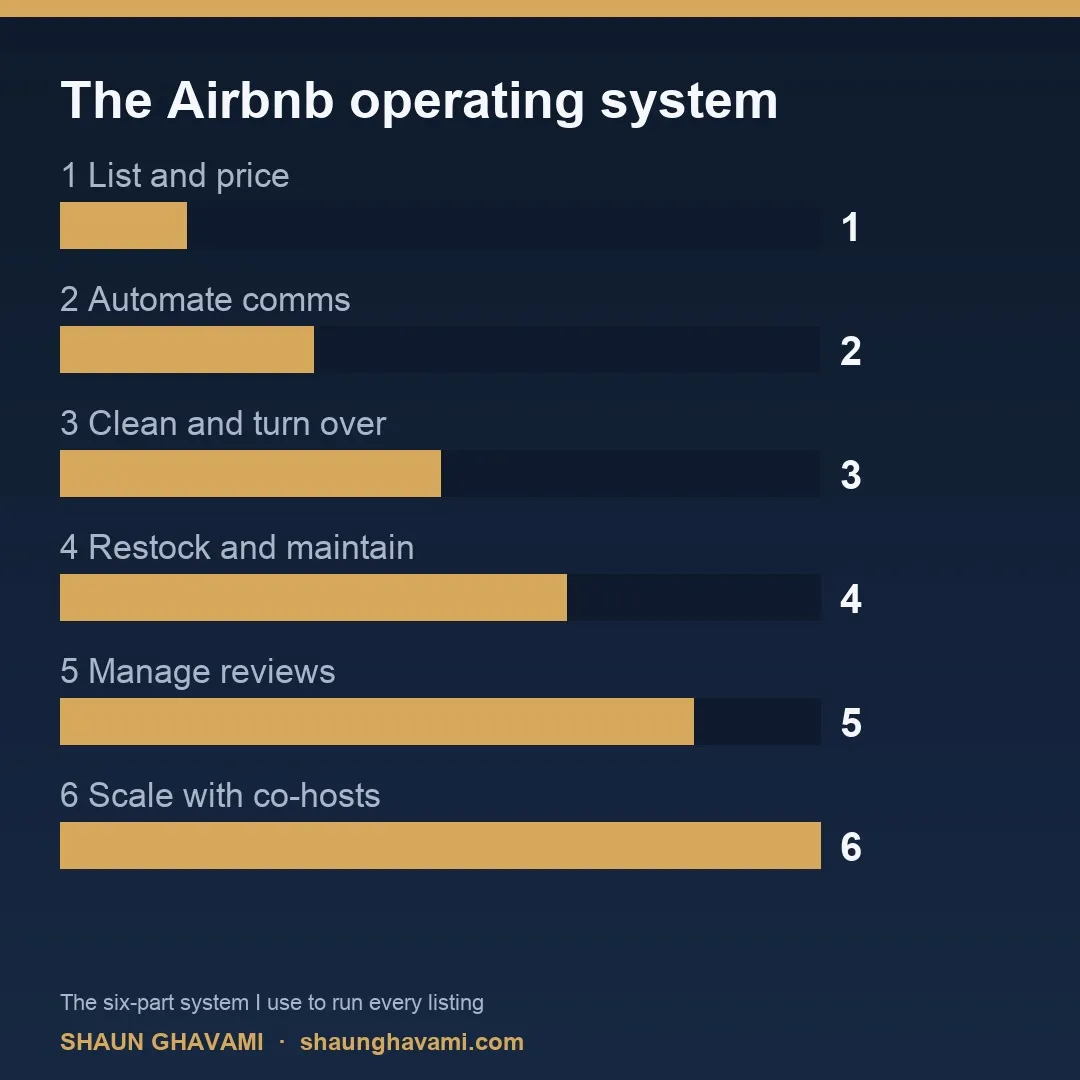
Nail these six and the rest of the business takes care of itself. The full setup, from first listing to first guest, lives in my pillar guide on how to start an Airbnb business. This piece is about what happens after the doors open.
1. Keep the listing optimized and priced for demand
Your listing is a storefront, and it decays. Photos get stale, competitors undercut you, and a price that worked in spring loses money in the shoulder season. I audit two things constantly:
2. Automate guest communication
Guest messaging is where new hosts drown. The same questions come in at all hours: how do I check in, what is the wifi, where do I park. Answer them once, then automate. I set scheduled messages for booking confirmation, check-in instructions the day before arrival, a mid-stay check, and checkout reminders, so most guests never have to ask. That frees me to handle the messages that actually need a human. I lay out the exact templates and triggers in Airbnb message automation.
Clear house rules cut the other half of the messages. When expectations are written down and shown up front, you get fewer surprises and better reviews. Here is how I structure mine in Airbnb house rules.
3. Cleaning and turnovers
The turnover is the heartbeat of the operation. A guest checks out at 11, another checks in at 3, and in those four hours the place has to be reset to hotel standard. Cleanliness is the single category guests rate hardest, so this is not where you cut corners. I run turnovers off a written checklist so nothing gets missed whether I clean or a pro does: strip and launder, sanitize kitchen and bath, restock consumables, inspect for damage, then stage and spot-check against the listing photos. The room should match the pictures every single time. My full turnover process is in how to clean an Airbnb.
Cleaning also costs money, and how you handle the cleaning fee affects both your margin and your conversion. I break down how to set it in Airbnb cleaning fees.
4. Restocking and supplies
Running out of toilet paper is a one-star review waiting to happen. I keep par levels for every consumable, the way a restaurant does, and restock on every turnover: toiletries, paper goods, coffee, dish soap, trash bags, and a few backups stored on site. Buy these in bulk. The per-unit cost drops and you stop making emergency store runs. A cheap supply closet is the difference between a smooth operation and a frantic one.
5. Maintenance and the physical asset
Every property is slowly breaking. Guests are harder on a place than you are, and small issues become bad reviews if you ignore them. I do a quick maintenance sweep during turnovers, batteries, drains, leaks, HVAC filters, anything squeaky or loose, and I keep a shortlist of a handyman, a plumber, and an electrician I can call same day. The goal is to catch problems before a guest does. Preventive maintenance is cheaper than an emergency, and far cheaper than the review that follows one.
6. Reviews are the scoreboard
Reviews are the currency of this business. They drive your ranking, your conversion, and your price. Per Airbnb's reviews for homes policy, both you and the guest have 14 days after checkout to leave a review, reviews only post once both sides submit or the window closes, and a listing needs at least three reviews before its star rating shows in search. Guests rate on cleanliness, accuracy, location, check-in, and communication.
My system is simple: earn the five stars during the stay, not after. Nail the check-in, keep the place spotless, respond fast, and make the listing accurate so nobody is surprised. Then ask for the review politely at checkout. Never buy or fake reviews. The whole model runs on trust.
Want the system that runs this on autopilot? Shaun teaches the full co-hosting operation inside 10XBNB. Get the free Airbnb co-hosting training.
The tools and team that make it run
None of this scales on willpower. It scales on a few systems and a small bench of reliable people. Here is the stack I lean on for every property:
Notice the theme. Every tool removes you from a task that does not need you, and that is the whole game. A listing that needs your hands on it all day is a job. A listing that runs on locks, software, and a good cleaner is a business, and that is what lets one operator run ten doors instead of one.
Your weekly operating rhythm
Put together, a normal week is quieter than beginners expect. Most days you are approving bookings and answering the rare message the automation did not cover. The real work clusters around turnovers: confirm the cleaner, restock, and spot-check the photos. Once a week I glance at pricing against the calendar and the next two weeks of demand. Once a month I reconcile the books and read back through recent reviews for patterns, since a repeated note about the shower or the wifi is a maintenance ticket, not a one-off. That is the rhythm. Build the systems once, then the business mostly runs itself while you decide whether to add the next door.
7. Money: bookkeeping and taxes
Treat this like a business from day one, because it is one. I track every dollar in and out per property, so I always know the real margin after fees and turnovers. Two money facts every operator should know:
Clean books are not busywork. They tell you which property to double down on and which to drop, and they make tax season a non-event.
8. Scaling: from one listing to a portfolio
One listing is a side income. A system is a business. The way you grow without buying more real estate is co-hosting: you run the operation for other owners and take a share of the revenue. The owner keeps the asset, you keep the system. This is how I manage a nine-figure portfolio I do not own.
The moment your own listing runs on autopilot, you can offer that same operation to a busy owner down the street. Learn the model in how to become an Airbnb co-host. It is the fastest way I know to grow Airbnb income without tying up capital in property.
Whether you run one door or fifty, the operating system is the same six parts on repeat. Build the system once, then copy it. Start with the fundamentals in my pillar guide on starting an Airbnb business, then come back and run the loop.
Everything above works whether you hold the lease or not, and the specifics of starting without owning the property are worth reading before you commit to either path.
Budget matters just as much as operations, so see how much it actually costs to start an Airbnb, and if you are starting with little cash, how to start an Airbnb with no money lays out the low-capital paths.
Frequently asked questions
How do you run an Airbnb business day to day?You run a repeating loop: keep the listing optimized and priced, automate guest messaging, clean and turn the place over between stays, restock supplies, handle maintenance, earn reviews, and keep clean books. The operators who systemize that loop grow; the ones who improvise burn out.
How much time does it take to manage an Airbnb?Once the systems are built, a single listing takes only a few hours a week, mostly turnovers and the occasional guest issue. Automating your messaging and running a written cleaning checklist cut the workload the most. Adding co-hosts is how you run more listings without adding hours.
Can you run an Airbnb remotely?Yes. With automated messaging, smart locks, a reliable cleaner, and a local handyman, you can operate a listing from anywhere. I manage properties I have never spent a night in. The key is systems and trusted local help, not being on site.
How do you get 5-star Airbnb reviews?Earn them during the stay, not after. Nail check-in, keep the place spotless, respond to messages fast, and make the listing accurate so nothing surprises the guest. Then ask politely at checkout. Per Airbnb, both sides have 14 days to review and a listing needs three reviews before its rating appears.
Do I need a business license to run an Airbnb?It depends entirely on your city. Short-term rental rules are local, and some places require a permit, a license, or a tax registration while others do not. Always confirm the current ordinance with your local government before you list.
How do you scale an Airbnb business without buying property?Co-hosting. You run the day-to-day operation for other owners and take a share of the revenue, so you grow income without a down payment or a mortgage. It is how I manage a large portfolio I do not own.
Want to run this as a real business? Shaun teaches the exact co-hosting operating system inside 10XBNB. Get the free Airbnb co-hosting training.

.png)

Be Part of our Community.
Let’s transform properties into powerhouses.
