
July 13, 2026
How to Start an Airbnb Without Owning Property
By Shaun Ghavami

Yes, you can start an Airbnb without owning any property. I have built most of my hosting income doing exactly that. There are three real routes. You can co-host, also called co-listing, where you run someone else's property for a share of the revenue. You can use rental arbitrage, where you rent a unit long term, then re-list it as a short-term rental with your landlord's written permission. Or you can start a property management business and run listings for owners under a contract. Co-hosting is the one I steer beginners to first, because it needs no property, no lease, and almost no starting cash.
I co-founded a Vancouver management company that runs a portfolio worth more than $100 million in homes we manage but do not own, and I got there after starting with a single $65-a-night spare bedroom. So none of this is theory for me. Below I break down all three paths, then go deep on the co-hosting model, which is where I tell almost everyone to begin.
The three ways to run an Airbnb without owning property
Every no-ownership path falls into one of three buckets. Here is how they compare on the things that decide whether you can start this month or not.
RouteProperty you needCash to startHow you get paidBest forCo-hosting / co-listingNone. You run owners' listingsVery low10% to 30% of each booking, commonly about 20%Beginners with no property and little cashRental arbitrageA unit you rent, with written permissionRent, deposit, furnishingNightly revenue after rent and platform feesPeople with some capital and a willing landlordProperty managementNone. You contract with ownersLow to moderateA management fee set in your contractOperators ready to run many listings at once
The short version: co-hosting asks the least of you and carries the least risk. Arbitrage can pay more per unit, but it ties you to a lease and real monthly costs. Property management is the same skill as co-hosting turned into a business you run across many owners. If you want the full picture of the model as a business, my guide to starting an Airbnb business covers the operations side in depth.
Route 1: Co-hosting, the path I recommend first
Co-hosting means you operate an Airbnb that someone else owns. The owner keeps the asset and the liability that comes with it. You handle the work, the guest, and the day-to-day, and you take a cut of the revenue. Airbnb has this built into the platform: an owner can add you as a co-host and set your payout inside their account. If you want the plain-English version of the model, read what Airbnb co-listing is before you go further.
This is not a fringe idea anymore. Airbnb launched its Co-Host Network in October 2024, and at launch it already listed more than 10,000 experienced co-hosts across 10 countries. Airbnb built it to connect owners with experienced operators, and hosts on the network help manage about seven properties each on average. That gap is your opening.
What a co-host actually does
The job is the operations of hosting without the ownership. On the properties I co-host, that means:
Some co-hosts do only the guest communication. Others run the whole operation, cleaning included. Your fee tracks how much you take on. If you want the role spelled out step by step, I wrote a separate guide on how to become an Airbnb co-host.
How co-hosts get paid
Airbnb does not set your fee. The owner and the co-host agree on it, and the owner sets up the payout inside their account. According to the Airbnb Help Center, the owner can choose from four payout structures: the cleaning fee, the cleaning fee plus a percentage, a straight percentage of each booking, or a fixed amount. The co-host then has 14 days to confirm or decline that arrangement before any money moves.
In practice, co-host fees run from about 10% to 30% of each booking, and land near 20% for most arrangements. Guest-communication-only deals sit at the low end. Full-service arrangements that include cleaning and turnovers reach the top. The chart below shows the typical spread.
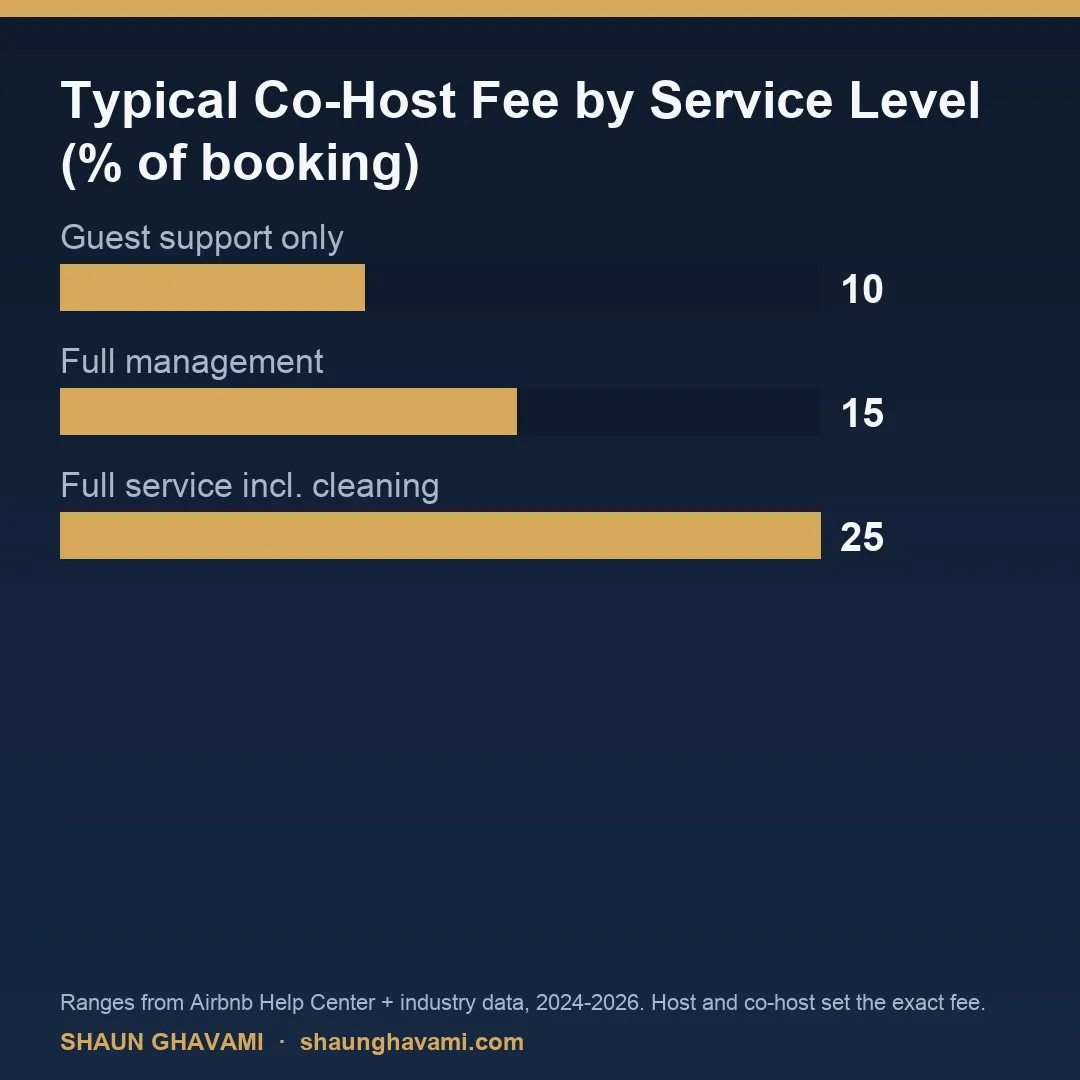
For a deeper breakdown of rates and how to price yourself, see my post on Airbnb co-host pay and fees.
Why I send beginners here first
Three reasons. You risk almost no money, because you are not signing a lease or buying furniture. You are not on the hook for the mortgage or the damage, because the owner owns the place. And you learn the real skill of hosting on someone else's asset before you ever put your own capital at stake. Once you can run one listing to a five-star standard, owners start asking you to run theirs.
Route 2: Rental arbitrage
Rental arbitrage means you rent a unit on a normal long-term lease, then list it as a short-term rental and keep the difference between what you pay in rent and what you earn in nightly bookings. It can pay more per unit than co-hosting, because you keep the booking revenue instead of a percentage. It also carries far more risk.
You are signing a lease, so you owe that rent whether or not the calendar fills. You furnish the place out of pocket. And you must clear two gates before you host a single night: your landlord has to permit it in writing, and your city has to allow short-term rentals at that address. Skip either one and you can lose the unit or face fines.
The landlord permission piece is where most arbitrage plans die, so I wrote a full playbook on how to convince your landlord to allow Airbnb. If you are weighing this against co-hosting, my side-by-side on co-listing versus rental arbitrage lays out the trade-offs in numbers.
On the money side, remember that Airbnb takes a cut on every booking. On the standard split-fee model, Airbnb's service fee page lists a guest service fee of roughly 14% to 16.5% of the booking subtotal and a host fee of about 3%. Your real margin is nightly revenue minus rent, minus cleaning, minus those platform fees. Run that math before you sign anything.
Route 3: Property management
Property management is co-hosting grown into a business. Instead of running one or two listings as a side income, you sign management contracts with several owners and run their properties as a service, often across Airbnb, Vrbo, and direct bookings. You charge a management fee, usually a percentage of the revenue you produce.
This is the model my Vancouver company runs, and it is how you scale past a handful of doors. It also asks more of you: systems for cleaning and maintenance, a team, insurance on the business, and real accountability to owners who are trusting you with their asset. I would not start here. I would earn my way here by co-hosting well first.
Which route should you pick?
Match the route to what you actually have right now.
For almost everyone reading this, the honest answer is co-hosting first, then decide later whether to add arbitrage or management on top.
Want the exact co-hosting system I use? I teach the whole playbook, from finding owners to running a listing to five stars, inside 10XBNB. Get the free Airbnb co-hosting training
How to start co-hosting this month
Whichever route you pick, get the real numbers first. See how much it costs to start an Airbnb business, the fuller build in how to start an Airbnb co-hosting business, and if cash is the real constraint, how to start an Airbnb with no money.
Frequently asked questions
Can you really run an Airbnb without owning or renting a property?Yes. Co-hosting lets you operate a property that someone else owns and rents to guests. You handle the hosting work and take an agreed share of each booking, and you never sign a lease or buy the home. It is the only one of the three routes that needs no property and almost no starting cash.
How much do Airbnb co-hosts make?A co-host fee usually runs from about 10% to 30% of each booking, and sits near 20% for most arrangements. Guest-communication-only deals pay at the low end, and full-service arrangements that include cleaning reach the high end. Your total income depends on the property's nightly rate, its occupancy, and how many listings you run.
Is co-hosting allowed on Airbnb?Yes. Airbnb has a built-in co-host tool that lets an owner add a co-host and set their payout, and in October 2024 it launched a Co-Host Network that connects owners with experienced local co-hosts. Co-hosting is an official part of the platform, not a workaround.
How is rental arbitrage different from co-hosting?With arbitrage you rent a unit yourself, pay the rent every month, and keep the nightly booking revenue. With co-hosting you never rent or own anything. You run an owner's listing for a percentage. Arbitrage can pay more per unit but carries the lease and the monthly cost, while co-hosting carries far less risk.
How much money do you need to start?Co-hosting can start for almost nothing, because you are not buying property or furniture. Rental arbitrage needs first and last month's rent, a deposit, and the cost of furnishing the unit, which often runs into several thousand dollars. That gap is the main reason I point beginners to co-hosting.
Do you need a license to co-host an Airbnb?It depends on your city. Short-term rental rules are set locally, and the permit usually attaches to the property and the owner rather than the co-host. Always confirm the rules for the exact address with the local government before you take on a listing.
Want the co-hosting playbook? Shaun teaches this system inside 10XBNB. Get the free Airbnb co-hosting training

.png)

Be Part of our Community.
Let’s transform properties into powerhouses.
