
July 13, 2026
The Airbnb Co-Hosting Agreement: What to Include (Clause-by-Clause Outline)
By Shaun Ghavami

An Airbnb co-hosting agreement is a written contract between a property owner and a co-host that spells out the services, the pay, and who is responsible for what. Airbnb does not require one, and the platform's built-in co-host tools already handle permissions and payouts inside the app. A written agreement still protects both sides by putting the commission, payout timing, scope, expenses, and exit terms in plain language before anyone starts. Below is a clause-by-clause outline you can use as a starting template. This is educational, not legal advice: have a local professional review your version, because short-term rental rules vary by city.
I have co-hosted a large portfolio for owners over the years, and the deals that stayed clean were the ones where we agreed the terms up front and wrote them down. The messy ones always traced back to something we never put on paper. So treat this as the conversation you need to have with an owner, turned into a document.
What is a co-hosting agreement, and do you need one?
A co-host runs part or all of another person's Airbnb: guest messaging, pricing, cleaning coordination, check-ins, and problem-solving, in exchange for a share of the revenue. If you are new to the model, start with what Airbnb co-listing is and then how to become an Airbnb co-host.
Airbnb does not force you to sign anything beyond its own co-host terms inside the app. A separate written agreement is not a legal requirement, it is a business safeguard. It matters most when money, damage, or a breakup is involved, because a plain document settles the question before emotions do. If you are handling other people's property and income, a one-page agreement is cheap insurance.
The core clauses to include
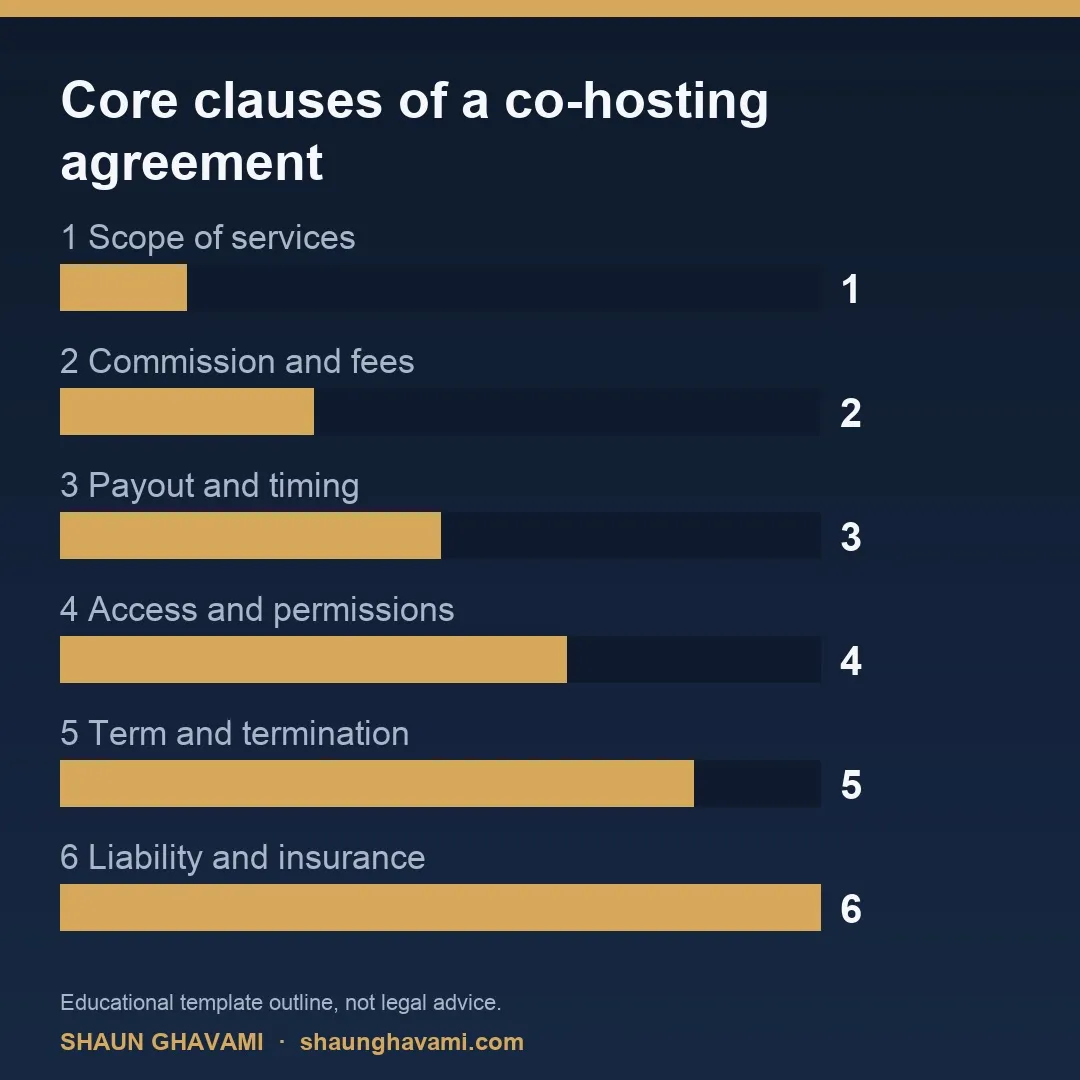
Here is the outline. Each clause below answers one question that otherwise turns into a dispute later.
1. Parties and property
Name the owner, name the co-host, and identify the exact property or listing the agreement covers. If you manage several of an owner's listings, list each one or attach a schedule. Simple, but it prevents "which place did we mean" arguments.
2. Scope of services
This is the clause people underwrite. Spell out exactly what the co-host does and what stays with the owner. Be specific: guest communication, calendar and pricing management, coordinating cleaning and turnovers, restocking supplies, handling maintenance requests, review management, and guest issue resolution. If a task is not listed, agree whether it is included or billed separately. Vague scope is the single biggest source of friction.
3. Commission and fees
State the pay clearly: a percentage of booking revenue, a flat monthly fee, or a per-booking amount. Most co-hosts charge between 10% and 30% of booking revenue, commonly around 20%, with the rate rising as the co-host takes on more of the operation. Critically, define what the percentage applies to. Is it the nightly revenue, the total payout, before or after the cleaning fee? For a full breakdown of the models, see my guide on how co-hosts get paid and set their fees, and for real dollar examples, how much Airbnb co-hosts make.
4. Payout mechanics and timing
Decide how the money actually reaches the co-host. Airbnb has a built-in system for this. Per Airbnb's co-host payout rules, only the listing owner can set up the payout, and it can be a percentage per booking, a fixed amount, or the cleaning fee. The co-host is paid after the guest checks in, generally by the end of the business day after the check-in date. Your agreement should say whether you use Airbnb's native co-host payout or settle off-platform, and when each cycle is due.
A contract is only worth signing if the arrangement pays, so I ran the numbers in whether the co-hosting model is worth it.
5. Expenses and reimbursements
Who pays for consumables, restocking, minor repairs, and emergency maintenance? Set a spending threshold the co-host can approve without asking (for example, small repairs under a set dollar amount), require owner sign-off above it, and define how reimbursement works and how fast. Keep receipts a stated requirement.
6. Access and account permissions
Airbnb lets an owner grant graded access instead of handing over the whole account. A listing can have up to 10 co-hosts, and per Airbnb's co-host permission levels the owner can choose full access, calendar and messaging access, or calendar access only. Your agreement should name the permission level granted and state that the owner stays responsible for the listing. Never run a co-host arrangement by sharing a password; use the permission tools.
7. Term and termination
State a start date, whether the term is open-ended or fixed, and the notice period for either side to exit (14 or 30 days is common). Cover what happens to in-flight bookings, final payouts, and access removal on the way out. A clean exit clause is what lets both sides walk away without a fight.
You need someone across the table before a contract means anything, and my outreach method is in getting your first co-hosting clients.
8. Liability, insurance, and indemnification
Say who carries what insurance, who is responsible for guest damage or injury claims, and how disputes are handled. Note whether the owner's short-term rental policy covers the co-host's activities. This is the clause your professional reviewer will care about most, so leave room for their input.
9. Communication and performance standards
Set expectations you can measure: guest response times, a reporting cadence to the owner (weekly or monthly), how urgent issues get escalated, and any performance targets like maintaining a review rating or occupancy floor. Clear standards protect the co-host as much as the owner, because they define what "doing the job" means.
10. Confidentiality and local compliance
Add a short confidentiality line covering guest data and owner financials, and a clause requiring the arrangement to follow local law. Short-term rental rules are set by cities and counties, not by one national code. Point to your local ordinance, and see my overview of short-term rental laws for how varied they are before you finalize anything.
The clauses you need depend on which role you are actually filling, a distinction I draw in co-hosting or property management.
Want the full co-hosting system? I walk through agreements, pricing, and landing owners step by step. Get the free Airbnb co-hosting training.
Clause cheat sheet
If you only keep one thing from this page, keep this. Each clause exists to answer a single question:
ClauseWhat it should answerScope of servicesExactly which tasks the co-host owns, and which stay with the ownerCommission and feesThe percentage or flat fee, and the exact revenue it applies toPayout and timingHow and when the co-host is paid, and whether it runs through AirbnbExpensesWho pays for supplies and repairs, the approval limit, and reimbursement termsAccess and permissionsWhich Airbnb permission level the co-host receivesTerm and terminationStart date, notice period, and how either side exits cleanlyLiability and insuranceWho insures the property and who carries responsibility for claimsCommunicationResponse times, reporting cadence, and how decisions get made
A weak agreement is only one of the ways this goes wrong. I gathered the others in mistakes new co-hosts make.
How Airbnb's built-in co-host tools fit
A written agreement and Airbnb's in-app tools work together, they do not replace each other. Airbnb handles two of the mechanical pieces for you: graded account access through its permission levels, and the co-host payout so a share of each booking routes to the co-host automatically. Your document handles everything Airbnb does not: the exact scope, expenses, insurance, termination, and performance standards.
Set up the Airbnb side to match your paper. If the agreement says the co-host manages the calendar and messages but not payouts to your bank, grant the matching permission level and nothing more. When the app and the agreement say the same thing, there is no gap for a problem to slip through.
Common mistakes to avoid
Before you sign: local rules and a professional review
Two final reminders, because they are the ones that cause real trouble. First, short-term rental law is local. As the Wikipedia overview of short-term rentals lays out, cities set their own rules on licensing, lodging taxes, day caps, and zoning, and they vary widely. Your agreement should require compliance with whatever applies at the property.
Second, this outline is a starting point, not a finished contract. Have a local attorney or a qualified professional review your version before either party signs, especially the liability and insurance clauses. The cost of a review is small next to the cost of a dispute over someone else's property. Once your terms are set, my guide to starting an Airbnb business shows where a clean co-hosting deal fits in the bigger plan.
A co-hosting agreement is only one piece of the paperwork. If the model itself is still unclear, start with what a short term rental actually is, and if the property is leased rather than owned, how to convince your landlord to allow Airbnb covers the conversation that has to happen before any agreement matters. The full short term rental guide for beginners ties the whole setup together.
Frequently asked questions
What is an Airbnb co-hosting agreement?It is a written contract between a property owner and a co-host that defines the services the co-host provides, the pay, and the responsibilities of each side. It usually covers scope, commission, payout timing, expenses, access, termination, and liability. Airbnb does not require it, but it protects both parties.
Do I legally need a co-hosting agreement for Airbnb?No. Airbnb does not require a separate agreement beyond its own in-app co-host terms. A written agreement is a business safeguard, not a legal mandate. It matters most when money, property damage, or ending the arrangement is involved, because it settles the terms in advance.
What should an Airbnb co-hosting agreement include?At a minimum: the parties and property, scope of services, commission or fee and what it applies to, payout mechanics and timing, expenses and reimbursement, account access and permissions, term and termination, liability and insurance, communication standards, and a local-compliance clause.
How do you handle the co-host's pay in the agreement?State the amount (a percentage of booking revenue, a flat fee, or a per-booking amount) and exactly what it applies to. Then define how it is paid. Airbnb's payout tool lets the owner route a percentage, fixed amount, or the cleaning fee to the co-host after guest check-in, and only the owner can set it up.
Can you use Airbnb's built-in co-host tools instead of a written agreement?They work best together. Airbnb's tools handle graded account access and the co-host payout inside the app, but they do not cover scope, expenses, insurance, termination, or performance standards. A written agreement fills those gaps, and you set the app permissions to match it.
Should a lawyer review my co-hosting agreement?Yes. This outline is educational, not legal advice. Short-term rental laws vary by city, and the liability and insurance terms carry real risk, so have a local attorney or qualified professional review your version before anyone signs.
Turn a clean agreement into a real co-hosting business. See how I structure deals with owners and run the operation. Get the free Airbnb co-hosting training.

.png)

Be Part of our Community.
Let’s transform properties into powerhouses.
