
July 20, 2026
Airbnb Occupancy Rate: How to Calculate It and What Counts as Good
By Shaun Ghavami
Airbnb occupancy rate is the share of your available nights that actually get booked. You calculate it by dividing booked nights by available nights over the same period, then multiplying by 100. Book 18 nights out of 27 that were open and your occupancy rate is about 67%. As a rule of thumb, a healthy short-term rental often runs somewhere around 50% to 70% depending on the market and the season, but there is no single national number worth quoting, so the smarter move is to pull your own market's figure and track your own. Higher is not automatically better either, because a full calendar at a weak nightly price can earn less than a moderate calendar at a strong one.
I have booked more than five million dollars in stays across a portfolio I manage for other owners, and occupancy is one of the first numbers I check on any listing. It tells you fast whether a problem is your price, your calendar, or your listing. Here is how to calculate it correctly, what a good rate really means, how to find your market's number, and the levers that move it.
What Airbnb occupancy rate actually measures
Occupancy rate answers one question: of the nights your place was open for booking, how many sold? It is a demand-and-pricing signal, not a revenue figure on its own. A listing can sit at 90% occupancy and still underperform if the nightly rate is too low, and a listing at 55% can out-earn it at a stronger price. That is why I always read occupancy next to your nightly rate, never alone.
The one thing to get right is what counts as an "available" night. Some hosts and tools treat every calendar night as available. Others exclude nights you deliberately blocked for personal use or maintenance. Both are valid, but pick one and stay consistent, because switching the denominator changes the number without anything real changing on your calendar.
How to calculate occupancy rate (worked example)
The formula is simple:
Occupancy rate = (booked nights / available nights) x 100
Here is a worked example with assumed inputs, so treat these numbers as illustration, not a market benchmark. Say you list a place for a full 30-day month but block 3 nights for your own trip. That leaves 27 available nights. Over the month, 18 of those nights get booked.
InputExample valueDays in the month30Nights you blocked (personal use)3Available nights27Booked nights18Occupancy rate18 / 27 = 0.667 = about 67%
If you instead counted all 30 calendar nights as available, the same 18 booked nights would read as 18 / 30, or 60%. Same real calendar, different denominator, six points of difference. This is exactly why you compare your number only to numbers calculated the same way. Run the math monthly and quarterly so seasonal swings do not fool you.
What is a "good" occupancy rate for Airbnb?
Here is the honest answer most articles dodge: there is no reliable single "average" occupancy rate you should measure yourself against, and I am not going to invent one. It depends on your market, your property type, your price, and the season. A beach town in July and a business-district condo in February live in different worlds.
As a working rule of thumb, many healthy short-term rentals run roughly 50% to 70% occupancy across the year, and I treat that as a sanity check, not a target. If you are well under that band in a strong market, something is usually off with your price, your minimum-night rule, or your listing quality. If you are pinned near the top of it, you may be leaving money on the table and could raise your rate. The band is a starting point for a conversation, not a scoreboard.
What matters more than any benchmark is your own trend. Is this quarter better than the same quarter last year at the same or higher nightly rate? That comparison, on your own listing, tells you far more than a borrowed average ever will. Occupancy is one input into whether the whole thing works, which I cover in is Airbnb still profitable.
Want the full system behind the numbers?
I teach how to build Airbnb income, with or without owning property, in a free session.
and learn how the top hosts read their own data.
How to find your market's occupancy number
Instead of chasing a national average, pull the number for your specific market. Market-data tools like AirDNA estimate occupancy, nightly rates, and revenue by city and neighborhood from real booking data, and that local figure is what you should compare against. A good comp is a similar-sized property, in your area, in the same season.
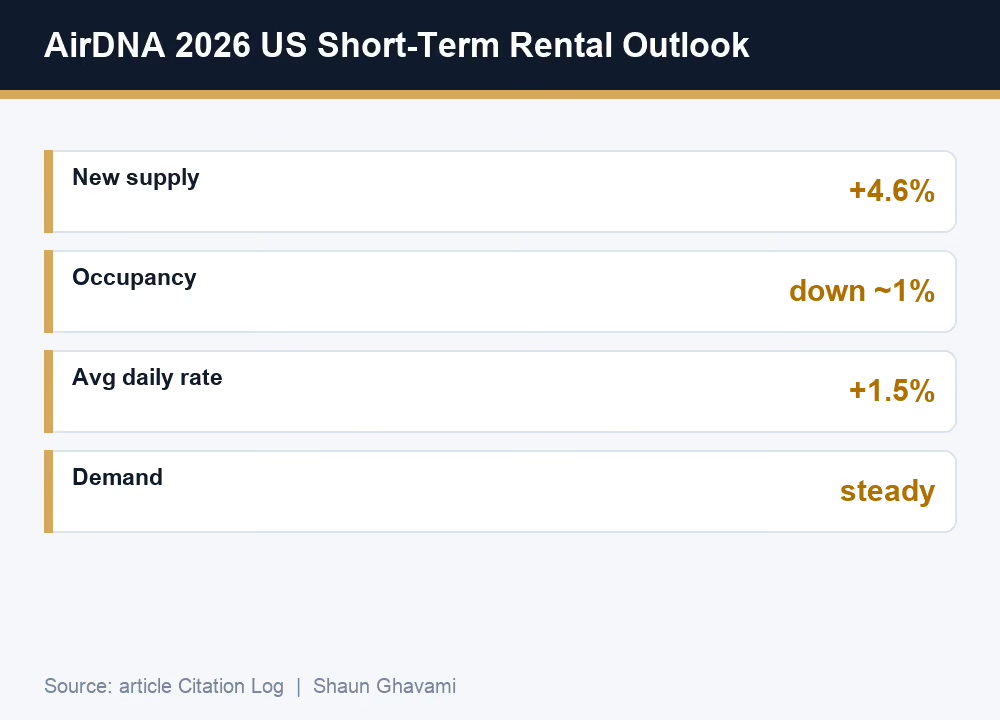
The wider market backdrop matters too, because it shapes what is realistic. In its 2026 outlook, AirDNA projects US short-term rental supply growing about 4.6%, well below the roughly 20% surges of 2021 and 2022, with demand steady and average daily rates up around 1.5%, and it calls this the best demand backdrop since 2021, with occupancy easing by about a point. You can read the release from AirDNA's 2026 outlook. The plain reading for a host: new competition is arriving more slowly than it did a few years ago, so a well-run listing has room to hold its occupancy and its rate.
The levers that raise your occupancy rate
Occupancy is not luck. It moves when you pull the right levers, and these are the ones I work in order.
Price
Price is the fastest lever. If your calendar is empty in a market that is booking, your rate is almost always too high for your reviews and photos. If it is full weeks out, your rate is likely too low. Dynamic pricing that flexes with demand and season usually beats a flat rate. I go deep on this in how to price your Airbnb, because price and occupancy are two dials on the same machine.
Minimum-night rules
A high minimum-night requirement filters out shorter trips and can leave gaps you never fill. Loosening minimums on weeknights, or allowing shorter stays to plug orphan nights between bookings, often lifts occupancy without touching your rate.
Calendar and availability
Occupancy cannot rise on nights that are closed. Open a wider booking window, keep your calendar current, and stop blocking nights out of habit. Prompt acceptance and fast replies also help, since Airbnb rewards responsive hosts and guests book the host who answers first.
Reviews and rating
Higher-rated listings get chosen more, so review quality feeds occupancy. Airbnb Superhost status, which needs a 4.8 or higher overall rating among its criteria, is a trust signal guests filter for. Better amenities are part of earning those reviews, which I cover in the best Airbnb amenities.
Seasonality
Some months will never hit peak occupancy, and that is fine. Plan for it: lower rates and shorter minimums in your slow season to keep nights filling, then push rate in your peak when demand does the work for you.
The full tactical playbook for filling the calendar, from listing photos to promotions, lives in how to increase Airbnb bookings. This article is about the metric; that one is about the moves.
Why higher occupancy is not always the goal
Chasing 100% occupancy is a rookie mistake. If your place is booked every single night, you have almost certainly priced too low and are trading dollars for a busy calendar and more wear on the property. Your real target is the mix of occupancy and nightly rate that produces the most revenue after costs, sometimes measured as revenue per available night.
A quick illustration with assumed numbers: 27 nights booked at $150 is $4,050, while 18 nights booked at $250 is $4,500 with less cleaning, less turnover, and less wear. Fewer nights, more money. That trade-off is the whole reason you read occupancy and rate together, and it is central to how to run an Airbnb business as a business rather than a hobby. If you co-host for owners, your pay is usually a share of the revenue you produce, so this same math is your income, which is why I dig into it in how much Airbnb co-hosts make.
Ready to build the whole operation?
If you want the step-by-step for starting and scaling without owning the real estate,
and copy the playbook I use across my portfolio.
Put occupancy in context
Occupancy rate is a fast, honest read on demand, and it is worth tracking every month. Calculate it the same way every time, compare it to your own history and your local market rather than a made-up national average, and read it next to your nightly rate. When you set up your first listing, build the habit of measuring from day one. My how to start an Airbnb business guide walks the full launch and ties every one of these numbers together.
Frequently asked questions
What is a good occupancy rate for Airbnb?There is no single "good" number that fits every listing, so treat any benchmark as a rule of thumb rather than a target. Many healthy short-term rentals run roughly 50% to 70% occupancy across the year, depending on the market, property type, and season. The more useful test is whether your rate is improving versus your own history at the same or a higher nightly price.
How do you calculate Airbnb occupancy rate?Divide your booked nights by your available nights over the same period, then multiply by 100. For example, 18 booked nights out of 27 available nights is 18 divided by 27, which is about 67%. Decide whether blocked personal nights count as available and stay consistent, because changing the denominator changes the result.
What is the average Airbnb occupancy rate?There is no single reliable national average worth quoting, because occupancy varies widely by city, property type, and season. Rather than borrow a number, pull your own market's figure from a data tool like AirDNA and compare similar properties in your area. Directionally, AirDNA's 2026 outlook has US supply growing about 4.6% with steady demand and occupancy easing by roughly a point.
Is occupancy rate or nightly price more important?Neither one alone tells you enough, which is why you read them together. A full calendar at a low price can earn less than a moderate calendar at a strong price, with more cleaning and wear. Your real goal is the combination of occupancy and rate that maximizes revenue after costs.
How can I increase my Airbnb occupancy rate?Start with price, since it is the fastest lever, and use dynamic pricing that flexes with demand and season. Then loosen high minimum-night rules, keep your calendar open and current, respond fast, and earn stronger reviews. Lower rates and shorter minimums in your slow season keep nights filling when demand is thin.
What is AirDNA and do I need it to find my occupancy rate?AirDNA is a short-term rental data tool that estimates occupancy, nightly rates, and revenue by city and neighborhood from real booking data. You do not strictly need it to calculate your own occupancy, but it is the practical way to find a realistic local benchmark to compare against. Match your listing to similar properties in your area and season for the fairest comparison.

.png)

Be Part of our Community.
Let’s transform properties into powerhouses.
