
August 14, 2026
How to Write an Airbnb Listing Description (With Templates)
By Shaun Ghavami
.png)
To write an Airbnb listing description that books, open with a specific moment your guest will have instead of a feature, then break the body into short, skimmable sections: the space, the amenities that actually matter, the area, and the logistics. Write each amenity as a benefit, not a bare list. Tailor the emphasis to the guest you want (a family, a business traveler, a group). Place your property type and location naturally in the first two sentences so a reader and Airbnb search both understand what this is. Close with a plain, honest line about check-in and rules. The copy-paste templates below give you a starting frame for each property type.
I have written and rewritten hundreds of these across a portfolio worth over $100 million that I manage for other owners, and I started with a $65-a-night spare bedroom. The pattern that converts is almost never the fanciest paragraph. It is the clearest one. Below is exactly how I structure a description, the guest-type tweaks I make, and three templates you can adapt tonight.
Start with a moment, not a feature
Your first line is the only sentence most guests read before they decide to keep scrolling or move on. Do not open with "Welcome to my apartment" or "This 2-bedroom condo has." Both waste the one line that matters. Open with the small, specific moment the guest is buying.
Put them in the space. "Wake up to coffee on a west-facing balcony before the city gets loud" beats "Great location with nice views" every time, because one is a picture and the other is a claim. The property management team at RedAwning makes the same point: a captivating opening line paints a mini scene the reader can step into, rather than announcing the room type.
Here is the same listing, two ways.
Before: "Cozy 1-bedroom apartment in a quiet neighborhood, close to everything. Fully equipped kitchen and fast WiFi."
After: "Drop your bags, pour a glass of wine, and watch the sun go down over the harbor from your own balcony. This quiet one-bedroom in [neighborhood] puts the water on one side and the best coffee on the block on the other."
The "after" still names the room type and the WiFi later. It just earns the read first.
Structure it so a phone can skim it in ten seconds
Most guests read on a phone, thumb moving fast. If your description is one long block, they bounce. Break it into labeled sections with a line or two each, and use short bullets for anything scannable. Hostaway frames the winning structure the same way: a benefit-led opening, then a skimmable body of specific amenities, distances, and nearby attractions written for human readers first.
The sections I use, in order, are the anatomy in the graphic below.
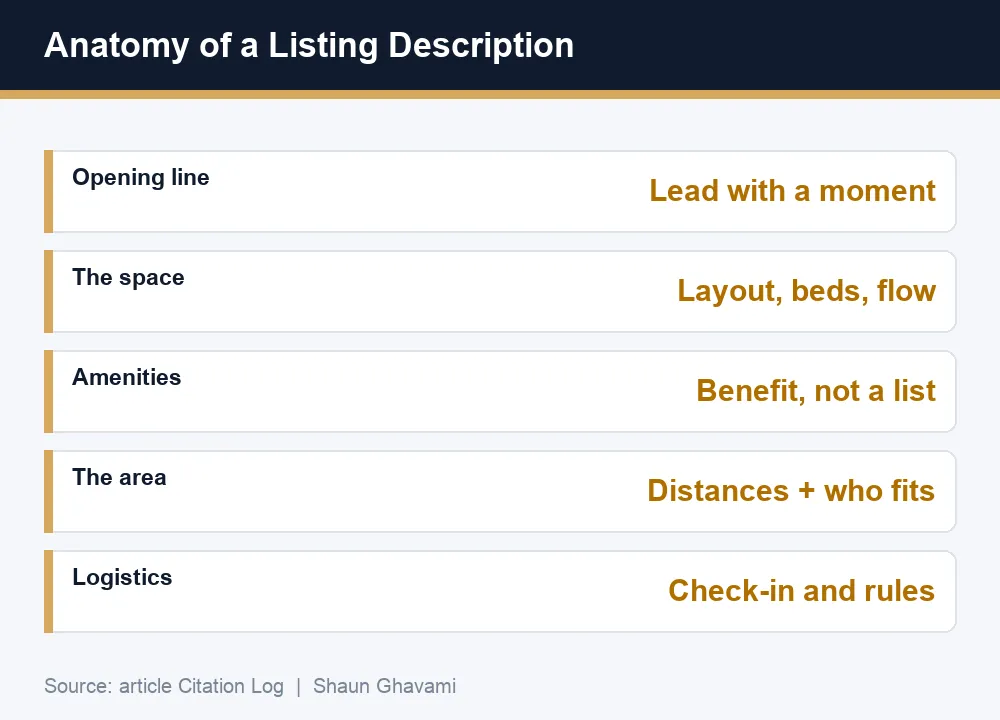
A quick rule for amenities: name the benefit, not just the object. "Fast WiFi" is a spec. "Fast fiber WiFi that holds a video call from the desk by the window" is a reason to book. Do the same for the details that carry weight, and if you are not sure which ones move the needle, the guest filters guide you toward the amenities guests actually filter for. Writing the description well is one piece of a bigger job, so treat it as part of how you optimize your Airbnb listing overall, not a one-off.
Write for the guest you actually want
A description that tries to please everyone reads like it was written for no one. Decide who your place is best for, then lead with what that guest cares about. A family scanning for a week in July does not read the same way a solo consultant booking two nights does.
Here is how I shift the emphasis by guest type. Same house, different first paragraph.
| Guest type | Lead with | Details to surface early |
|---|---|---|
| Families | Space and safety | Layout, crib or pack-n-play, fenced yard, parking, distance to a park |
| Business travelers | Work and speed | Desk, fast WiFi speed, self check-in, quiet, distance to the office district |
| Groups and friends | Gathering and beds | Sleeping setup per room, table that seats everyone, deck or hot tub, noise rules |
| Couples and getaways | The feeling | The view, the soaking tub, walkable dinner spots, privacy |
You do not have to guess who to write for. Look at your market and your bed count. A one-bedroom near a convention center writes itself toward business and couples. A five-bedroom with a yard writes toward families and groups. RedAwning puts this first for a reason: knowing your target guest is what lets the rest of the copy speak their language.
Place your property type and location without stuffing
Airbnb search reads your title and description text, so the words a guest would type should appear where they read naturally. That means your property type ("cabin," "loft," "beach house") and your location (the neighborhood or the nearest landmark) belong in the first two sentences and once or twice more where they fit.
What you should not do is repeat "Scottsdale vacation rental Scottsdale Airbnb Scottsdale condo" until it reads like a robot wrote it. Guests feel keyword stuffing instantly, and it reads as low trust. Write the sentence you would say out loud, then check that the property type and place are in it. If they are, you are done. Natural placement beats density every time, and it keeps the copy in the same honest voice as the rest of how you run an Airbnb business.
The description does the persuading, but the title does the opening, and I have gathered working examples in listing titles that get clicks.
One more real-world note: your description sets an expectation that your nightly rate has to match. If the copy promises a getaway and the price says budget crash pad, guests get confused. Keep the story and the number in step when you decide how to price your Airbnb.
Copy-paste templates by property type
Use these as a frame, not a fill-in-the-blank you paste as-is. Swap in your real details, cut anything that is not true, and keep the opening line specific to your place. Brackets mark what you replace.
City apartment or condo
[Open with a moment: e.g., "Start the morning with coffee on the balcony
before the city wakes up."] This [studio / one-bedroom] sits in [neighborhood],
[X]-minute walk from [landmark or transit] and steps from [cafe / restaurant].

THE SPACE
- Sleeps [N]: [bed setup, e.g., queen bed plus a full sofa bed]
- [Desk / workspace] with fiber WiFi that holds a video call
- Full kitchen with [specifics: dishwasher, coffee maker, etc.]

THE AREA
- [X] min to [main draw], [X] min to [second draw]
- Best [coffee / dinner / bar] within a [X]-minute walk

GETTING IN
- Self check-in with a [smart lock / keypad]; instructions sent before arrival
- [Parking / transit note]

A few house rules keep the building happy: [quiet hours, no parties, max guests].
Family house (whole home)
[Open with a family moment: e.g., "Pancakes on the deck, kids in the yard,
and a driveway you can actually park in."] This [3-bedroom] home in [area]
gives everyone room to spread out, [X] minutes from [park / beach / attraction].

THE SPACE
- Sleeps [N] across [X] bedrooms: [bed setup per room]
- [Fenced yard / crib / pack-n-play / high chair] ready for little ones
- Kitchen and dining that seat the whole group

THE AREA
- [X] min to [family attraction], [X] min to groceries
- [Playground / pool / trail] within [X] minutes

GETTING IN
- [Self check-in details]; [parking for X cars]

House rules: [quiet hours, no smoking, pets: yes/no]. We keep it simple and clean.
Cabin, beach house, or unique stay (groups and getaways)
[Open with the feeling: e.g., "Hot tub under the stars, no cell signal, and
the only sound is the creek."] This [cabin] outside [town] is built for
[a group weekend / a quiet reset], [X] minutes from [trailhead / lake / town].

THE SPACE
- Sleeps [N]: [bed setup], plus [deck / fire pit / hot tub]
- [Full kitchen / grill] and a table that seats everyone
- [Wood stove / AC / heating] for the season

THE AREA
- [X] min to [main activity], [X] min to the nearest store
- [Hikes / wineries / beach] a short drive away

GETTING IN
- [Self check-in / lockbox]; [directions note for low signal]

House rules: [max guests, quiet hours, no events without approval].
Whatever template you start from, the finished description works hardest when the photos back up every promise, so line the copy up with your Airbnb photography before you publish. A described balcony with no balcony photo reads as a red flag.
A co-host workflow: writing a description for a client's listing
If you write descriptions for owners as a co-host, you are working from someone else's property and someone else's memory of it. My process keeps it accurate and fast.
First, I get the facts before I write a word. I ask the owner for the exact bed setup per room, the real walk and drive times to the two or three draws guests care about, the parking situation, the check-in method, and any rules the building or HOA enforces. I do not guess distances, and I do not invent amenities. If I cannot confirm it, it does not go in.
Second, I write the opening line last. I draft the sections first, because that is where the true details live, then I go back and pull the single best moment out of those facts to lead with. The hot tub, the walk to the beach, the desk with the view. The moment is always already in the notes.
Third, I match the owner's honesty level, not their hype level. Owners often want every adjective. My job is to cut the ones the photos cannot prove and keep the specifics that book. A description a co-host writes should read like the owner is being straight with the guest.
Fourth, I close the loop with rules and reviews. I make sure the description's rules line matches the actual Airbnb house rules on the listing, so guests are not surprised at check-in. Surprises at check-in are how you lose the five stars, and steady accuracy is a big part of how you earn 5-star Airbnb reviews. Getting the description honest is also the cheapest way to start a hosting business well, which sits inside the bigger question of how to start an Airbnb business that actually lasts.
A great description still has to match the room a guest actually sleeps in, which starts with choosing the right mattress, and if you welcome animals, say so plainly using the wording in running a pet friendly Airbnb.
Good copy is only half the job of a listing that converts, so pair it with Airbnb interior design ideas that give you something worth describing.
Frequently asked questions
Long enough to cover the space, the amenities that matter, the area, and how to get in, and no longer. That is usually a short opening line plus four labeled sections of a sentence or two each. Front-load the details that drive the booking, because most guests read on a phone and skim rather than read every word.
Lead with a specific moment the guest will have, not the room type or a generic claim like great location. Something like waking up to coffee on the balcony puts the reader in the space and earns the next line. You can name the property type and WiFi right after; the first line only has to make them keep reading.
Yes, and you should, because Airbnb search reads your title and description text. Put your property type and location in the first two sentences and once or twice more where they read naturally. Do not repeat the same phrase over and over, since keyword stuffing reads as low trust to both guests and search.
Lead with space and safety, then surface the details a parent scans for early: the bed setup per room, a crib or pack-n-play, a fenced yard, parking, and the distance to a park or the main attraction. Keep the rules line clear and simple. Families book on practical fit more than on mood.
Yes, in one short, plain line near the end, covering the essentials like quiet hours, max guests, smoking, and parties. Matching the description to the actual house rules on your listing prevents check-in surprises. Guests respect clear expectations, and clarity here protects your reviews.
Get the exact facts from the owner first: bed setup per room, real walk and drive times, parking, check-in method, and any building rules. Draft the sections before the opening line, then pull the single best moment from those facts to lead with. Never invent an amenity or a distance you cannot confirm.



Be Part of our Community.
Let’s transform properties into powerhouses.
