
August 14, 2026
Airbnb Security Deposits and Damage: How It Actually Works
By Shaun Ghavami
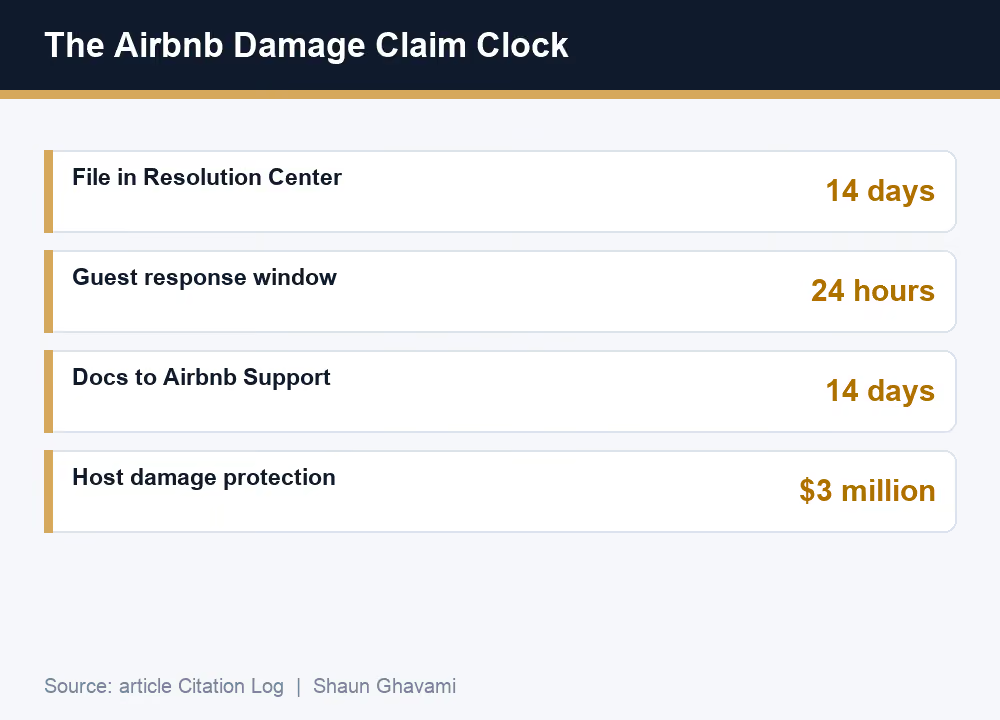
Airbnb does not run a traditional up-front cash security deposit the way a long-term lease does. There is no pot of the guest's money sitting in escrow for you to deduct from at checkout. If a guest damages your place, you recover the money after the stay through Airbnb's Resolution Center, backed by Host damage protection under AirCover for Hosts. The whole process runs on three deadlines: you file the reimbursement request within 14 days of the guest's checkout, the guest then has 24 hours to respond, and to involve Airbnb Support you submit your supporting documentation within 14 days of the damage or loss.
I have hosted more than 3,000 guests and I manage a portfolio worth over $100 million for owners who never touch the day-to-day. Damage is rare, but it happens, and the hosts who actually get reimbursed are never the ones who send the angriest message. They are the ones with a dated evidence file and a clock they did not miss. This is the process I run on every incident.
So is there an Airbnb security deposit or not?
Not in the way most people mean it. A landlord collects a deposit before move-in, holds the cash, and deducts from it at the end. Short-term rentals work the other way around: the guest pays for the stay, and if something gets broken you make a claim afterward through the platform.
That one difference should change how you operate. Your protection is not money you are already holding, it is the quality of the paperwork you can produce inside two weeks. Everything upstream of the claim matters more because of it: a clear set of Airbnb house rules the guest agreed to, a sane guest screening process before you accept the booking, and a plan to prevent parties, which is where most serious damage starts.
Prevention is cheaper than any claim you will ever win.
What Host damage protection actually is
Host damage protection is the damage piece of AirCover for Hosts. Airbnb states the amount as $3 million per the Airbnb Help Center, and it sits alongside the other pieces of AirCover: guest identity verification, reservation screening, liability coverage, and a 24-hour safety line.
Two of those are worth knowing about because they work before anything breaks. Guest identity verification is the tool Airbnb uses to verify guest identities, and it is required for travelers to 35 countries, though a government ID is not collected in every case. Reservation screening uses machine learning to flag reservations at higher risk of a party or a property-damage incident, and Airbnb currently offers it in the United States, Canada, and Australia.
I am not going to compare coverage products here. That is a separate decision to make with a licensed professional who knows your property and your local rules. This article is about the platform process: how you ask, what you show, and by when.
The three deadlines that decide whether you get paid
This is the part worth memorizing. Airbnb publishes three separate clocks for a damage claim, and two of them are both 14 days but count from different events, which is exactly where hosts trip.
| Step | Deadline | Counted from |
|---|---|---|
| File the reimbursement request in the Resolution Center | Within 14 days | The guest's checkout |
| Guest responds to the request | 24 hours | When you send the request |
| Submit supporting documentation to involve Airbnb Support | Within 14 days | The damage or loss |
All three come from Airbnb's Host damage protection help article. Read the second and third rows again: the filing clock starts at checkout, but the documentation clock starts at the damage or loss. If a guest breaks something on night two of a nine-night stay and you find out on night three, your documentation window opened then, not at checkout.
My working rule is much simpler than the policy: file within 48 hours of the turnover, every time. Waiting costs you nothing but risk, and a cleaner's memory of which room was wrecked fades fast.
The evidence file that actually gets claims paid
A claim is not a story, it is a file. Mine has five things in it every single time, and I build it in the same order:
Protecting the downside is part of why the approach in passive income from short-term rentals holds up over time.
- Timestamped before photos. Shot at the end of every turnover, before the next guest arrives. This is the piece almost nobody has, and it is the piece that wins arguments. A clean, dated photo of the sofa from last Tuesday makes the burn mark undeniable.
- Timestamped after photos. Same angles, same rooms, taken the moment the damage is found. Wide shot for context, close shot for detail. Same angles matter more than good angles.
- The cleaner's report. A short written note from whoever did the turnover, sent the same day, saying what they found and where. My Airbnb cleaning process has a damage-check step baked into the checklist so this arrives without me asking for it.
- Receipts, invoices, or repair quotes. Original purchase receipts for replacement, or a written quote from a local trade for repair. On anything over a few hundred dollars I get two quotes and submit the lower one. It reads as reasonable, and reasonable gets paid.
- The Airbnb message thread. Every relevant conversation, on-platform. If a guest admits to spilling wine in a text message you exchanged off the app, that admission may as well not exist. Keep it all in Airbnb messages.
Two habits make this file easy to assemble. Set clear Airbnb checkout instructions so guests report accidents before they leave rather than hoping you miss it, and photograph the property at the end of every clean, not just the ones where something looks off.
What a claim file looks like, with numbers
Here is an illustrative example with assumed inputs, not a real client incident. A guest cracks a glass shower panel and stains a bedroom rug:
| Line item | Document submitted | Amount |
|---|---|---|
| Replacement shower panel and fitting | Written quote from a local glazier | $740 |
| Bedroom rug replacement | Original purchase receipt | $310 |
| Extra deep clean beyond the standard turnover | Invoice from my cleaner | $95 |
| Total requested in the Resolution Center | Filed the morning after checkout | $1,145 |
Every line has a document behind it and every number came from someone other than me. That is the whole trick. A request for $1,145 with three attachments is a different conversation from a request for "about twelve hundred" with none.
Why damage claims get denied
The failures repeat, and almost all of them are self-inflicted:
- Filed late. The 14-day window from checkout closed. There is no version of this you can argue your way out of.
- It reads as wear and tear. Scuffed paint, a worn mattress, a tired sofa cushion. Those are operating costs, not damage, and treating them as damage weakens every real claim you file afterward.
- No before photos. Without a dated baseline you are asking someone to take your word that the stain was not already there.
- The conversation happened off-platform. Side deals over text or WhatsApp cannot be reviewed by Airbnb, so the evidence effectively vanishes.
- The amount is a guess. No receipt, no quote, no invoice, just a number. It gets challenged, and it should.
- The next guest already checked in. Once another party has been through the door, tying the damage to a specific guest gets very hard. This is why the same-day turnover photo matters so much.
One more that is less obvious: escalating emotionally before you file. If the thread is a fight, the facts get buried. Keep the tone flat, the same approach I use with difficult Airbnb guests generally.
Running the claim as a co-host, on the owner's behalf
If you manage listings for other people, the damage claim is a moment the owner remembers forever. Handle it well and you keep the account for years.
Agree these five things in writing before you ever need them, ideally inside the Airbnb co-hosting agreement:
- Who files. Usually you, since you hold the message thread and the photos. Say so explicitly.
- The absorb threshold. A dollar figure under which you simply replace the item and move on rather than filing. Small claims cost more in goodwill and review risk than they return.
- Who talks to the guest. One voice. Two people negotiating the same claim is how contradictions end up in the thread.
- Where the money lands. Reimbursement flows to the host account on the listing. Spell out how and when it reaches the owner, and who covers a repair paid out of pocket in the meantime.
- What documentation you keep. Turnover photos retained for a set period, quotes stored somewhere the owner can see them.
There is a ranking angle too. A damage dispute that spills into the public review exchange affects your ratings, and ratings feed the quality signals behind how the Airbnb algorithm works. Settle the money in the Resolution Center, not the review section. If you are still building the operating side, the full picture is in my how to start an Airbnb business guide.
Frequently asked questions
Airbnb does not run a traditional up-front cash security deposit the way a long-term lease does, so there is no held sum you deduct from at checkout. Instead, damage is recovered after the stay through the Resolution Center, backed by Host damage protection under AirCover for Hosts. Your protection comes from documentation, not from money you are holding.
You file the reimbursement request in the Resolution Center within 14 days of the guest's checkout. To involve Airbnb Support, you submit your supporting documentation within 14 days of the damage or loss, which is a separate clock that starts at a different moment. In practice, file within 48 hours of the turnover so neither window is ever close.
The guest has 24 hours to respond to your reimbursement request in the Resolution Center. If they do not respond within that window, the process moves forward and you can involve Airbnb Support with your documentation. Keep every message on the Airbnb platform so the whole exchange stays reviewable.
Airbnb states Host damage protection at $3 million as part of AirCover for Hosts. AirCover also includes guest identity verification, reservation screening, liability coverage, and a 24-hour safety line. The amount is the ceiling on the program, not a promise about any individual claim.
Five things: timestamped before photos from the previous turnover, timestamped after photos of the damage, a written report from your cleaner, receipts or repair quotes for every dollar you are asking for, and the on-platform Airbnb message thread. The before photos are the piece most hosts skip and the piece that settles disputes fastest.
Yes, and the co-host is usually the right person to do it because they hold the photos, the cleaner's report, and the guest message thread. Agree in advance who files, what dollar threshold is simply absorbed instead of claimed, who speaks to the guest, and how the reimbursement reaches the owner. Put all of it in the co-hosting agreement before you need it.
.png)


Be Part of our Community.
Let’s transform properties into powerhouses.
