
August 5, 2026
How Does the Airbnb Algorithm Work? Ranking Factors Explained
By Shaun Ghavami

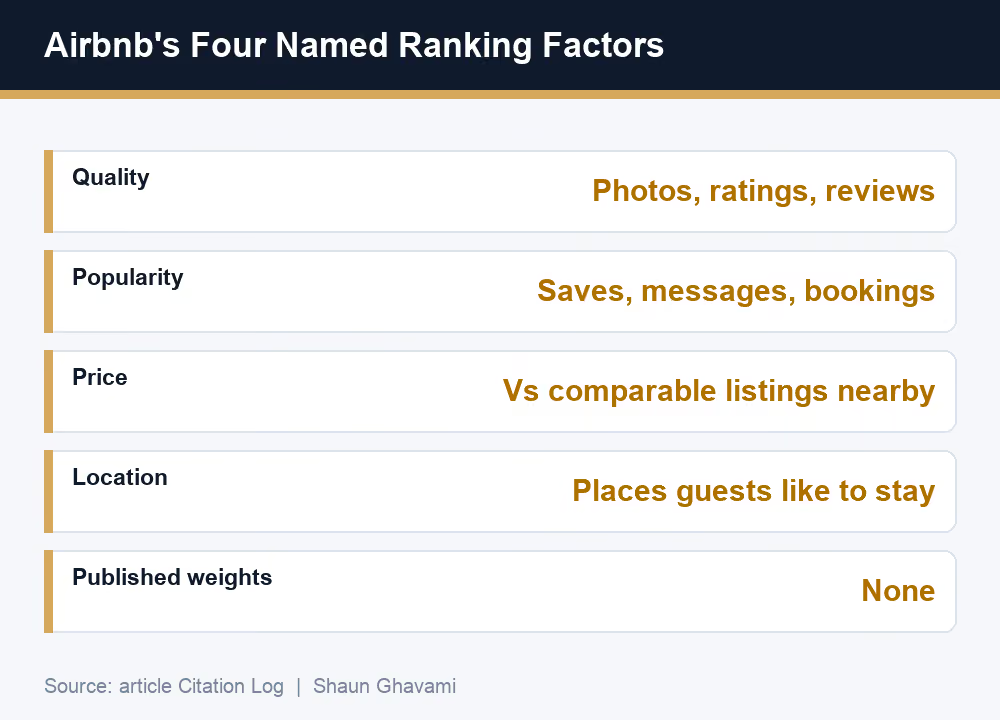
The Airbnb algorithm decides which listings a guest sees, and in what order, for the search they just ran. Airbnb names four things that influence that order: quality, popularity, price, and location. Quality comes from your listing content, ratings, and reviews. Popularity comes from how guests engage with your listing, including saves, messages, and bookings. Price is judged against comparable listings in the same area. Location is simply whether guests want to stay where your place sits. Airbnb publishes no weight or percentage for any of the four, so the practical job is to push every factor you actually control.
I have hosted more than 3,000 guests and I manage a portfolio worth over $100 million for other owners, and the listings that climb are rarely the nicest properties. They are the ones set up so a guest clicks, saves, messages, books, and then leaves a 5-star review. That chain is the algorithm in practice. Here is how each factor works, which levers sit in your hands, and the audit I run on a listing in its first 30 days.
The four factors Airbnb names
Airbnb's help center describes how the platform sorts millions of listings against a single search, and it names four influences by name. Everything else you read online is either a restatement of these four or a guess.
| Factor | What Airbnb says | Can you move it? |
|---|---|---|
| Quality | Higher quality listings with better ratings and reviews tend to rank higher in search | Yes, directly |
| Popularity | More popular listings tend to rank higher in search | Yes, but only through quality and price |
| Price | Listings priced below other comparable listings in the area tend to rank higher | Yes, directly |
| Location | Listings in places that guests like to stay tend to rank higher | No, not once you have bought or leased |
Quality
Airbnb assesses quality from your listing content (photos, videos, and descriptions), your ratings and reviews from guests, and communications between hosts and guests on the platform. That is a wide net, and it is the factor most hosts underwork. A complete listing with sharp photos, an honest description, and every real amenity checked gives the platform more to read and gives guests fewer reasons to hesitate. If you are deciding what to add first, start with the best Airbnb amenities for your property type.
Popularity
Popularity is measured by how guests engage with your listing: how often they save it to a wishlist, how often they message you, and how often they book. You cannot edit popularity directly. You earn it by giving people a reason to stop scrolling and a reason to trust what they see. The two edits with the fastest effect here are your cover photo and your title, and I break the title down in Airbnb listing title ideas.
Price
Airbnb compares your total price against other listings in the area with similar guest capacity and amenities, and says listings priced below those comparables tend to rank higher. Note the word comparable. A three-bedroom home with a pool is not competing with a studio, so the question is never whether you are cheap, it is whether you are sensibly placed against your true set. Pricing has enough moving parts to deserve its own process, which I cover in how to price your Airbnb.
Location
Airbnb says listings in places guests like to stay tend to rank higher. This is the one factor with no lever attached to it after the fact. You choose your location once, when you buy, lease, or take on a property, and then you live with it. That is exactly why location research belongs at the front of the process, before furniture and photos, as covered in how to start an Airbnb business.
What you control, and what the guest controls
Two different sets of inputs decide what a guest sees. One set belongs to you. The other belongs entirely to the person searching, and no amount of optimization touches it. Sorting your effort by that line is the single most useful thing you can do with this article.
Host-controlled factors
Airbnb lists these as things a host influences, per Airbnb's Help Center:
- Availability and booking flexibility. More open dates and a wider range of accepted trip lengths mean you are eligible for more searches in the first place.
- Pricing adjustments and discounts. Weekly and monthly discounts, and rate changes around demand, both count.
- Media quality. Photos, videos, and descriptions.
- Amenities and listing characteristics. These also decide which filters you survive.
- Hospitality standards, including Superhost criteria. Ratings, cancellations, and reliability.
- Host responsiveness. How quickly and consistently you reply.
Guest-side factors you cannot touch
The guest's own search shapes the result set before any of your work is considered: the location, dates, and guest count they typed, whether they are travelling with pets, which filters and map area they use, and their own past booking behaviour on the platform. Airbnb also says the algorithm encourages variety within search results, showing different hosts and different price ranges rather than a single block of near-identical homes. Practically, that means a guest running a narrow search may never see your listing no matter how well built it is, and that is not a failure on your part.
How the quality signals actually get built
Quality is not a setting. It is the output of five things you do repeatedly, and each one feeds the platform something to read.
Photos
Photos are listing content, which Airbnb names inside the quality factor, and they are also the thing that earns the click that becomes popularity. Cover the whole property, shoot in daylight, and lead with your strongest room.
Description and title
Both are listing content. Both also decide whether a click turns into a booking. Write the description so it answers the guest's first practical question in the opening line rather than in paragraph four.
Amenities
Amenities do double duty. They are part of the listing characteristics Airbnb names, and they decide which filtered searches you appear in at all. Check every amenity you genuinely provide, and only those, because anything overstated comes back as an accuracy complaint in your reviews.
Reviews and ratings
Reviews are the slowest signal to move and the hardest to fake, which is why they carry weight. Guests and hosts each have 14 days after checkout to write a review, so there is always a lag between fixing your operation and seeing it in your rating. Two Airbnb programs sit on top of this. Superhost is assessed quarterly on your trailing 12 months and requires a 4.8 or higher overall rating, at least 10 reservations (or 3 reservations totalling 100 or more nights), a 90% response rate within 24 hours, and a cancellation rate under 1%, per Airbnb's Superhost help article. Guest Favorites is a separate and newer badge, selected from factors including overall star ratings, review feedback, and category ratings, with a stated minimum of at least five guest reviews, and Airbnb evaluates listings for it automatically every day. If you are chasing either one, read how to become an Airbnb Superhost and Airbnb Guest Favorites.
Response speed
Host responsiveness is named as a host-controlled factor, and the Superhost standard puts a hard number on the floor: 90% of new messages answered within 24 hours. Guests usually message three or four hosts at once, so speed wins bookings on its own. Saved replies and scheduled messages carry most of the load here, which I set up using Airbnb message automation.
What Airbnb does not publish, and what hosts guess
This is where most algorithm articles go wrong, so I want to be blunt about the line between confirmed and assumed.
- There are no published weights. Airbnb names the four factors and never says how much each is worth. If an article tells you quality is a specific percentage of the algorithm, that number was invented.
- There is no public listing score. Airbnb does not show hosts a single numeric ranking score in the dashboard. Your rating, category ratings, response rate, Superhost status, and Guest Favorite badge are the closest thing to a scoreboard you get.
- Internal system names are not something to chase. Optimizing for a name you read on a forum is not a strategy. The four public factors are.
- New-listing visibility is an operator observation, not a rule. Plenty of hosts, including me, have watched a fresh listing pick up early views and then settle. Airbnb has not published a new-listing boost, so treat it as something operators notice, not something you can count on or plan around.
The honest position is that you cannot reverse-engineer a ranking system nobody has documented. You can work every named factor until there is nothing left to fix, and that is enough.
Your first 30 days: what to actually do
Run this in order. It is the same sequence I use on a new client property before I touch anything clever.
- Days 1-3: complete the listing to 100%. Every field filled, every real amenity checked. A half-finished listing gives the platform less to read and gives guests a reason to bounce.
- Days 1-3: fix the cover photo and title. These two control whether the click happens, and the click is what popularity is made of.
- Days 4-7: open the calendar wide. Availability and trip-length flexibility decide how many searches you are even eligible for. A tight calendar removes you from the pool before quality is considered.
- Days 4-7: price against your true comparables. Same guest capacity, same amenity level, same area. Airbnb makes this comparison whether or not you do.
- Days 7-30: answer every message fast. Target well inside the 24-hour Superhost standard. Set up saved replies so you are not doing it by hand at midnight.
- Days 7-30: earn the first reviews deliberately. Reviews are the slow signal, and the first handful matter most because they carry the whole page for months. Ask at checkout, every time, and make the stay itself easy enough to review well.
- Day 30: review what changed, then repeat. Compare views, saves, and bookings against the previous period and fix the weakest of the four factors next.
If bookings are still thin after a full cycle, work through how to increase Airbnb bookings before you cut your rate again.
Running this as an audit on a client's listing (the co-host angle)
Here is the part most hosts miss. Almost everything above is operational work, not property work, which means you do not need to own a listing to get paid for doing it. This exact article is the audit I run for owners.
The conversation is easy because the problems are visible from the outside. Pull up the client's listing and score it on the four factors. Quality: how many photos, how complete is the description, what do the category ratings say. Popularity: is anything about the cover photo and title earning the click. Price: is it placed sensibly against true comparables or guessed. Location: fixed, so stop talking about it. You will usually find three or four unforced errors in the first ten minutes, and every one of them is fixable this week.
Owners pay for that because the outcome shows up on their next statement. Co-host pay is set by the listing owner and agreed between you, and industry-typical management commissions run in the 10% to 30% range, commonly around 20% depending on scope. That band is what the market pays, not an Airbnb-set rate. I started with a single $65-a-night spare bedroom and moved into running listings for other people, which is how the portfolio grew past $100 million in property I manage but do not own. The route in is laid out in how to become an Airbnb co-host.
Frequently asked questions
Airbnb matches every search against millions of listings and orders the results using four factors it names publicly: quality, popularity, price, and location. Quality comes from your listing content, ratings, and reviews. Popularity comes from how guests engage with the listing, including wishlist saves, messages, and bookings. Price is compared against similar listings in the same area, and location reflects whether guests want to stay where your property is.
No. Airbnb names the factors but does not publish a weight or a percentage for any of them. Any article that tells you quality is worth a specific share of the algorithm invented that number. Treat weighted breakdowns as guesses and work every factor you control instead.
Airbnb does not give hosts a single public ranking score in the dashboard. What you do get is your overall rating, your category ratings, your response rate, Superhost status, and the Guest Favorite badge. Those are the closest thing to a scoreboard, and they are built from the same signals the ranking factors read.
There is no published timeline, and it depends on how much booking and review activity your listing generates. Reviews are the slow part, since guests have 14 days after checkout to leave one. Changes to price, availability, photos, and amenities can affect which searches you appear in far sooner than that.
Airbnb lists host responsiveness among the factors a host controls, and the Superhost standard requires answering 90% of new messages within 24 hours. Fast replies also win bookings outright, because guests usually message several hosts at once and book whoever answers first. Both effects push the same way, so treat speed as standard practice rather than an experiment.
Yes, because most of what feeds the ranking factors is operational work rather than property features. A co-host can rebuild the photos, title, description, and amenity list, open the calendar, reprice against true comparables, and answer messages quickly. Location is the only named factor nobody can change once the property is chosen.

.png)

Be Part of our Community.
Let’s transform properties into powerhouses.
