
August 5, 2026
How to Screen Airbnb Guests Without Breaking the Rules
By Shaun Ghavami

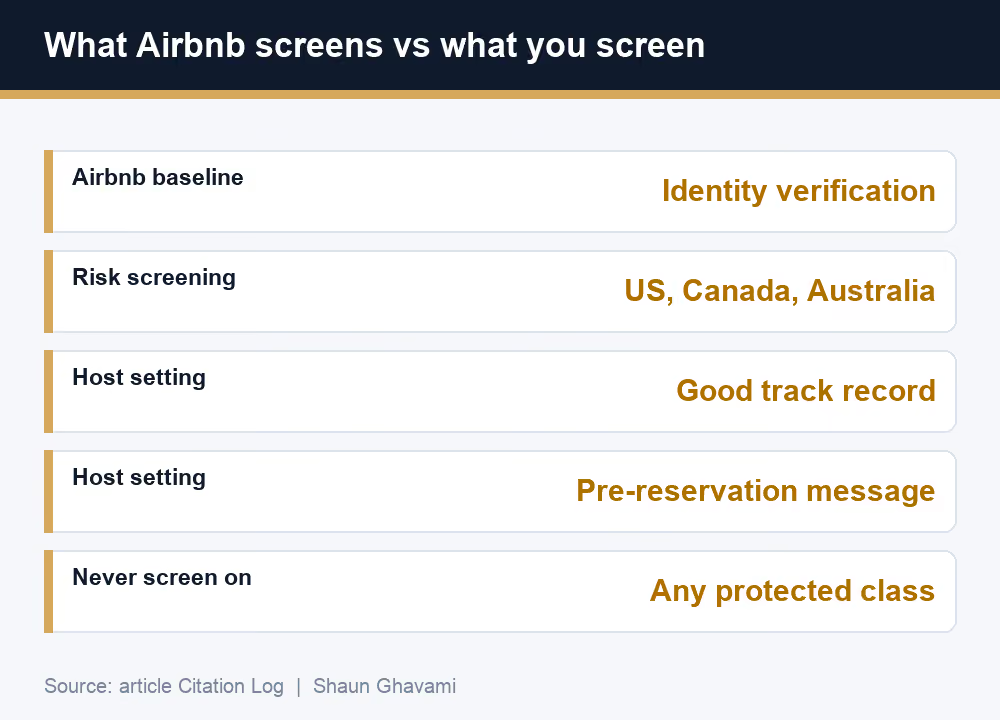
You screen Airbnb guests by judging behavior and trip facts, never the person. Airbnb has already verified the guest's identity before the request reaches you, so your job is the layer on top: turn on the booking settings that filter for a good track record, send one short pre-booking message asking the trip purpose, the real guest count, the arrival time, and confirmation they have read your house rules, then decide on the answers you get back. Every criterion you apply has to sit inside Airbnb's Nondiscrimination Policy, which means you assess conduct and never a protected characteristic.
I have hosted more than 3,000 guests across the portfolio my team manages for other owners, and almost every bad stay announced itself in the messages first. Not in a profile photo, not in a name, not in a hunch. In an answer that did not add up. If you are still setting up, read how to start an Airbnb business first, because half of screening is written into the listing.
Screen behavior and trip facts, never people
Read this before the tactics below. It is the boundary everything else stays inside.
Airbnb's Nondiscrimination Policy prohibits hosts from declining, charging differently, or applying different terms based on race, color, ethnicity, national origin, religion, sex, gender identity, sexual orientation, disability, or other protected characteristics. That is not a soft guideline. Hosts lose listings and accounts over it, and in many places it is also a matter of law.
The workable line is simple. Screen on what someone does and what the trip is: verified identity, prior host reviews, the purpose of the trip, the number of people staying, whether the answers stay consistent, and whether they agree to your house rules. Never screen on who someone is.
Your defense against ever crossing that line is a written standard. Decide the criteria once and ask every inquiry identical questions. A host who asks all ten the same four questions and declines the two who dodge them has a defensible record. One who decides case by case, on feel, does not.
One more trap: service animals are not pets, so a no-pets rule does not apply to them. Settle that in your house rules before a request arrives.
What Airbnb already screens before you see the request
Plenty of hosts build elaborate rituals for things the platform already handles. Know the baseline so you spend effort where it counts.
Every host, new co-host, and booking guest has to be identity verified, and the check runs a person's information against trusted third-party sources or a government ID (Verifying your identity on Airbnb, Airbnb Help Center). Airbnb also requires a full name, email address, confirmed phone number, and payment information before a booking can happen, and may ask for a photo of a government ID and a selfie (Booking requirements for reservations, Airbnb Help Center).
AirCover for Hosts adds guest identity verification, reservation screening, and a 24-hour safety line. Reservation screening uses machine learning to flag reservations at higher risk of a party or property damage incident, and Airbnb states it is currently available in the United States, Canada, and Australia (AirCover for hosts, Airbnb Help Center). Host outside those three countries and that layer is not working for you yet.
Two limits. Airbnb does not hand you a guest's government ID at booking, and you may request it afterwards only if your listing states it is required for legal or compliance reasons under the off-platform policy. Some regions also require guests to register with local authorities.
The booking requirements you can actually turn on
Airbnb gives hosts switches in booking settings. Most leave them at default, then complain about the bookings they get.
The two guest requirements sit behind Instant Book, so they only apply if it is on. The first is a good track record, which Airbnb defines as a guest who completed a reservation without incident or bad reviews. The second is a pre-reservation message, preset questions the guest answers as they book.
The timing settings reduce risk most. Advance notice (same day with a cut-off time, or at least one, two, three, or seven days) kills the impulse booking that arrives at 9pm for tonight. Preparation time gives your cleaner room. Minimum and maximum trip length filters the shapes you do not want, and if you never set a maximum, a 31-night cap applies automatically.
One tradeoff: requirements a guest does not meet can keep your listing out of that guest's search results entirely. Every filter trades volume for quality, worth weighing against the other factors in how the Airbnb algorithm works.
The six red flags that actually predict trouble
These are behavioral and trip-based. None involve who the guest is.
| Signal in the request | What it tells you | What to do |
|---|---|---|
| Vague or shifting trip purpose | The reason did not survive one follow-up | Ask once more. Decline if the story changes |
| A booking in the guest's own city | Not always bad, but the common party pattern | Ask the occasion, confirm the guest count |
| Guest count that does not fit the trip | Two booked, questions about parking for six | Restate max occupancy, ask them to correct it |
| Pressure to move off Airbnb | You lose the record, payment protection, support | Keep it on-platform. Decline if they push twice |
| New account plus evasive answers | New alone is fine. Dodging basics is not | Judge the answers, not the account age |
| Asking to break a house rule | The rule will be broken during the stay | Decline. It does not improve after check-in |
Be fair about the new-account flag. Everybody has zero reviews once, and refusing every new account drifts toward judging people rather than behavior. What matters is whether a guest with no history will answer four straightforward questions.
The local-booking flag needs the same care. Plenty are legitimate: a renovation at home, family visiting, a night away. It is a prompt to ask, not a reason to decline. The combination that predicts trouble is a local booking plus a vague occasion plus a moving guest count, covered in how to prevent Airbnb parties.
The pre-booking message that surfaces most problems
One message does most of the work. Send it to every inquiry, word for word, so your process stays consistent.
"Hi [name], happy to host you. So I can get the place ready, four quick things: 1) What brings you to [city]? 2) How many people will be staying in total, including children? 3) Roughly what time do you expect to arrive? 4) Can you confirm you have read the house rules, especially [your two most-broken rules]? Thanks."
Each question does a job. The trip purpose gives you something to check the other answers against. The guest count is the most useful number you will get, because occupancy mismatches sit underneath most party and damage problems. The arrival time shows who reads carefully. The house-rules confirmation puts their agreement in writing inside the Airbnb thread, which matters if you ever open a case.
You are grading the quality of the answers more than the content. A guest who answers all four in two lines is almost always fine. One who answers two of four earns a second message. If you send this often, save it as a template, the approach behind these guest communication templates.
How Instant Book changes the workflow
With Instant Book on, guests reserve without your approval, so screening moves from before the booking to right after it. Set the filters to handle the front end (good track record on, your four questions in the pre-reservation message, advance notice set) and the work does not disappear, it changes order. Every guest agrees to your house rules before booking, so make those rules specific.
Then send the same message the moment the booking confirms and read the answers as carefully as you would in a request. If something is wrong you can cancel, but know the cost first. Airbnb may apply fees or other consequences for cancelling a guest's reservation, and host cancellations damage the reliability record behind the Guest Favorites badge and Superhost status. Cancel for genuine safety and rule problems, not second thoughts.
One quirk: Instant Book is not available when a guest books within two days of check-in and needs to arrive outside your check-in window. Those arrive as requests instead, which hands back the approval step where it matters most.
Airbnb guest screening on behalf of an owner
Screening someone else's property adds a problem: you are making judgment calls with the owner's asset and account standing on the line.
Settle three things in writing before your first booking: who declines a request and on what criteria, who may cancel a confirmed reservation given the cost of a host cancellation, and what the fixed screening questions are. A written, identical-for-everyone standard is your discrimination defense as much as your operating process.
Document decisions inside the Airbnb message thread, not in a private text with the owner. If a stay goes wrong, that thread supports a claim through the Resolution Center. Damage recovery runs on deadlines (a reimbursement request within 14 days of checkout) rather than from cash you hold up front, covered in the Airbnb security deposit guide. If a guest is already in the property and behaving badly, that is how to deal with bad Airbnb guests.
Screening is one of the clearest pieces of value a co-host delivers, because most owners have no process at all. If you are building this into a service, becoming an Airbnb co-host covers the role and payout.
Frequently asked questions
Yes, but the reason has to be about behavior or trip facts, not the person. Declining because a guest will not confirm the guest count, dodges the trip purpose, or asks to break your house rules is legitimate. Declining based on race, religion, national origin, sex, gender identity, sexual orientation, disability, or any other protected characteristic violates Airbnb's Nondiscrimination Policy.
Screen on conduct and trip facts: verified identity, prior host reviews, the purpose of the trip, the number of people staying, whether the answers stay consistent, and whether they agree to your house rules. Write the criteria down once and ask every inquiry the same questions. Consistency is better screening and your best defense if a decision is questioned.
Not necessarily. Instant Book is what makes the two guest requirements available, a good track record filter and a pre-reservation message with your own questions, so switching it off removes those tools. Better to leave it on with the requirements enabled and your questions sent the moment a booking confirms.
Airbnb does not share a guest's government ID with you at booking. You may request it afterwards only if your listing states it is required for legal or compliance reasons under Airbnb's off-platform policy. Some regions also require guests to register with local authorities.
A vague or shifting trip purpose, a local booking with no clear occasion, a guest count that does not match the trip, pressure to move off the platform, a new account paired with evasive answers, and any request to break a house rule. Each one is about behavior, which makes them fair to act on.

.png)

Be Part of our Community.
Let’s transform properties into powerhouses.
