
August 5, 2026
How to Deal With Bad Airbnb Guests (Without Losing Your Rating)
By Shaun Ghavami
.png)
Dealing with a bad Airbnb guest starts with one question: is this guest unhappy, or is this guest breaking your rules? The correct response is opposite for each. An unhappy guest wants to be heard, and a fast partial resolution almost always costs less than the review they will otherwise leave. A rule-breaker gets no negotiation: keep every message on the Airbnb platform, document what happened, issue one clear warning, then bring in Airbnb Support. Cancelling mid-stay is the last move, because a host cancellation hits Superhost eligibility and your reliability record. After checkout, both of you have 14 days to write a review.
I have hosted more than 3,000 guests across a portfolio worth over $100 million that I manage for other owners, and collected over 1,000 five-star reviews doing it. None of that came from easy guests. It came from answering hard ones in a fixed order.
Step one: triage. Unhappy guest or rule-breaker?
Most hosts lose money getting this backwards. They argue with a guest who wanted a working shower, then try to accommodate a guest throwing a party. Sort the situation before you type a word.
| Signal | What it actually is | Correct response |
|---|---|---|
| Complaint about cleanliness, noise, wifi, temperature, a broken item | Unhappy guest | Reply fast, fix it or compensate, stay warm |
| Asking for something you never advertised | Expectation gap | Clarify politely, offer the nearest alternative |
| Extra people, unregistered pets, smoking, neighbor noise complaints | Rule-breaker | Document, one written warning, escalate |
| Party, threats, refusal to leave, safety risk | Serious violation | Contact Airbnb immediately, do not negotiate |
The tell: an unhappy guest describes a gap between what they expected and what they got. A rule-breaker describes nothing, because they hope you do not notice.
Both get easier upstream. Tight Airbnb house rules plus a real guest screening process at the booking stage kill most of these before check-in.
The unhappy guest: fix it inside the hour
Speed is the whole strategy. A guest who gets a reply in ten minutes rarely writes a bad review, even if the fix takes a day. One who waits four hours is already drafting one.
The message shape I use: acknowledge, act, then offer something concrete.
"Thanks for telling me, and I am sorry. That is not the standard I hold the place to. I have messaged the cleaner and they can be there by 2pm today. I am also refunding one night of the cleaning fee. Does 2pm work, or would later suit you better?"
Four things happen there: no excuses, a named action with a time on it, a number offered before they ask, and a question that turns a complaint into logistics. I keep versions in a library of Airbnb guest communication templates so nobody invents one under pressure.
Why a small refund is usually the cheap option
Run the numbers before you dig in over $60. Illustrative example, assumed inputs:
| Scenario | Total stars | Reviews | Average | Above the 4.8 Superhost bar? |
|---|---|---|---|---|
| Before | 98 | 20 | 4.90 | Yes |
| After one 1-star review | 99 | 21 | 4.71 | No |
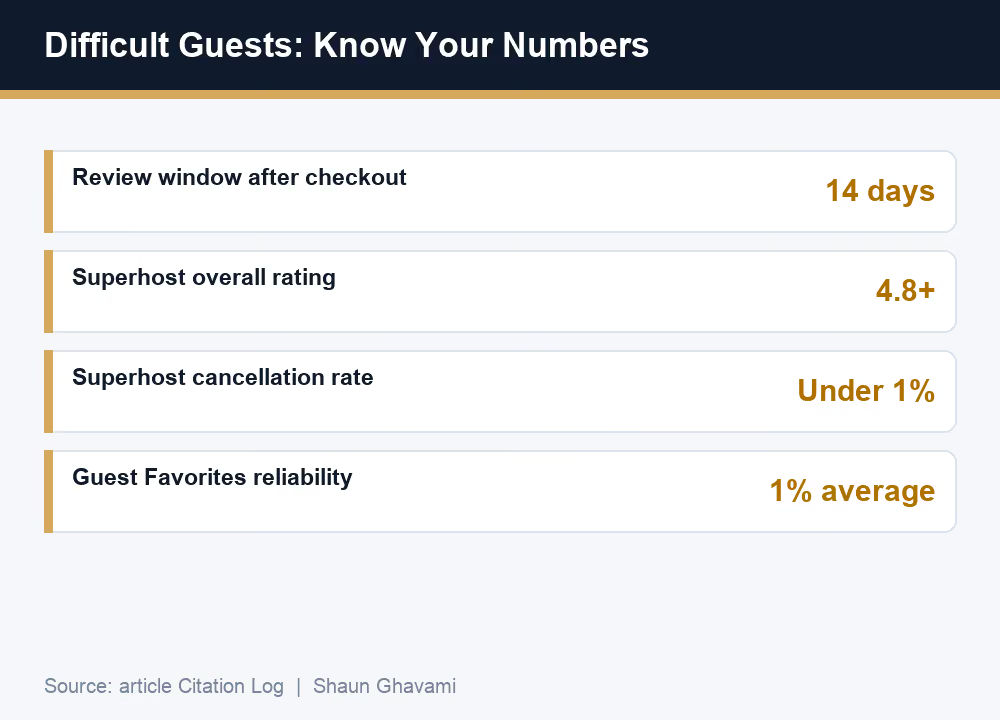
Superhost status requires a 4.8 or higher overall rating, per the Airbnb Help Center, plus a 90% response rate within 24 hours, a cancellation rate under 1%, and either 10 reservations or 3 reservations totaling 100 or more nights over the trailing 12 months. One review put that listing under the bar. A $60 goodwill refund on a $600 booking is 10% of one stay. The review taxes every future booking.
Do not pay off a guest inventing problems for a free trip. Pay to fix a real gap, fast.
The rule-breaker: document, warn once, escalate
Different guest, different playbook. The goal is not to make them happy, it is to build a clean record and end it.
- Move everything on-platform. If a neighbor calls or the guest texts your phone, summarize it back into the Airbnb thread: "Following up on our call at 9:40pm about the noise." Off-platform conversations cannot be reviewed by Airbnb.
- Document with timestamps. Noise-monitor readings, a neighbor's message, a photo of the extra cars. Facts with times on them, no adjectives.
- Issue one written warning. Quote the house rule they agreed to, state what has to change, give a deadline. One warning, not five.
- Escalate to Airbnb Support. If it continues, hand Airbnb the documented thread instead of arguing with the guest yourself.
Airbnb's Community Disturbance Policy is worth reading once so you know the language to use. It states that open-invite parties, disruptive gatherings, and other community disturbances are not allowed during a reservation, and it names types including excessive noise, excessive trash, trespassing, smoking and parking nuisances, and neighborhood vandalism. Advertising a listing as party friendly is prohibited. Airbnb describes an enforcement ladder from warnings, to listing suspension or removal, to account suspension or removal.
The policy sets no numeric occupancy limit. It targets behavior, not headcount, so your house rules have to carry the guest-count and visitor language. Parties are their own risk category, covered in how to prevent Airbnb parties.
Cancelling mid-stay, and what it actually costs
Sometimes a stay has to end early. If there is a safety risk, a threat, or an active party, contact Airbnb rather than handling it alone. AirCover for Hosts includes a 24-hour safety line for exactly this.
Outside a safety situation, know what a host cancellation costs:
- Superhost eligibility. The criteria include a cancellation rate under 1% over the trailing 12 months, assessed quarterly. One cancellation can put you over that line for a full year.
- Your reliability record. Airbnb describes Guest Favorites as requiring a superb record of reliability, with host cancellations and quality-related customer service issues of 1% on average, and it evaluates listings automatically every day. More in Airbnb Guest Favorites.
- Platform consequences. Airbnb applies its own consequences to host cancellations. I am not quoting a fee number, because the details depend on the situation. Check the cancellation policy in your dashboard first, and where possible let Airbnb Support make the call.
Cancel for safety without hesitation, and for almost nothing else. If a stay is merely unpleasant, finish it and handle it in the review.
The review: 14 days, and how to use them
Guests and hosts each have 14 days after checkout to write a review, per the Airbnb Help Center. That window is your only chance to warn the next host, and where plenty of hosts talk themselves into a mistake.
Writing an honest review of a bad guest
Write facts, not feelings. Describe behavior a future host can act on, leave out anything about the person, and never write something you would hate to see quoted back:
"Group arrived with more guests than the reservation listed and did not respond to messages about it until the second day. The home was left with significant extra cleaning required. I would not host this group again."
Specific, verifiable, unemotional. What it is not is retaliation. Do not threaten a review to win an argument, do not trade good reviews, and do not exaggerate.
Responding to an unfair review
You will get one eventually. The response is written for the next 200 people who read it, not for the guest who left it. Correct the record once, then stop.
"Thanks for the feedback. The wifi outage was a building-wide issue that started the evening of arrival, and we offered a partial refund and a mobile hotspot within an hour. It was restored the next morning. We are sorry the timing affected the stay, and we have since added a backup connection."
No sarcasm, no relitigating the guest's character, one factual correction plus what changed. That tells future guests you fix things.
Ratings and review content feed the quality signals behind how the Airbnb algorithm works. Recovering after a bad stretch is mostly stacking good stays, the path in how to become an Airbnb Superhost.
If they broke something
Damage runs on its own clock, separate from the review. File a reimbursement request in the Resolution Center within 14 days of the guest's checkout, the guest has 24 hours to respond, and to involve Airbnb Support you submit documentation within 14 days of the damage or loss. Full walkthrough in Airbnb security deposits and damage claims.
Keep the tracks separate. Money goes through the Resolution Center, warnings to future hosts go in the review.
How a co-host handles all of this so the owner never has to
Owners hire operators for the 11pm phone call, not the calendar. If you manage listings for other people, the guest problem is your product. Set it up so the owner hears about it after it is solved:
- Response-time standard. A target such as replying to any in-stay message within 15 minutes during waking hours, staffed accordingly.
- Pre-approved goodwill budget. A dollar figure you can spend without calling the owner. Without it your team stalls when speed matters most.
- Escalation thresholds. What you handle alone, what the owner hears the same day, and what triggers an Airbnb Support case.
- One voice to the guest. Owner and co-host both messaging produces contradictions that get quoted in a review.
- An incident log. Date, time, what happened, what you did. It supports damage claims and convinces the next owner to hire you.
Handled this way, difficult guests become a selling point rather than a liability. The full operating picture is in my how to start an Airbnb business guide.
Frequently asked questions
Decide first whether the guest is unhappy or breaking rules, because the responses are opposite. Reply to an unhappy guest fast, name a specific action with a time on it, and offer a resolution before they ask. For a rule-breaker, document everything in the Airbnb message thread, give one written warning, then contact Airbnb Support.
Refund quickly when the complaint describes a real gap you could photograph, such as a failed appliance or a cleaning miss. A partial refund on one stay is usually cheaper than a low review affecting every future booking. Do not pay a guest who is manufacturing problems for a free trip.
You can, but treat it as a last resort outside of safety situations. Superhost status requires a cancellation rate under 1% over the trailing 12 months, and Airbnb measures host cancellations in the reliability record behind Guest Favorites. For a threat, a party, or a safety risk, contact Airbnb rather than handling it alone.
Guests and hosts each have 14 days after checkout to write a review. Use it to write a factual account of what the guest actually did so the next host can decide for themselves. Describe behavior, not personality, and never use a review as a bargaining chip.
Write the response for future guests, not for the reviewer. Keep it short, correct one factual point, say what you changed as a result, and stop there. Sarcasm and long rebuttals do more damage to your listing than the original review did.
Handle it through the Resolution Center rather than the review. File a reimbursement request within 14 days of the guest's checkout, and the guest then has 24 hours to respond. To involve Airbnb Support, submit documentation within 14 days of the damage or loss.
.png)

Be Part of our Community.
Let’s transform properties into powerhouses.
