
August 5, 2026
How to Prevent Airbnb Parties and Noise Complaints
By Shaun Ghavami

You prevent Airbnb parties with settings, not vigilance. Airbnb's Community Disturbance Policy already bans open-invite parties and disruptive gatherings, and its reservation screening is built to redirect reservations that look higher risk before they reach you. Everything else is yours: a minimum stay that prices out the one-night party booking, booking requirements that stop unverified accounts booking instantly, a same-day booking cut-off, a stated guest count, written house rules, and a disclosed decibel monitor. If a party starts anyway, there is a step order, and it begins with a written message on the platform, not a drive to the property.
I manage a portfolio worth over $100 million for owners who mostly live somewhere else, and nearly every party problem I have seen traced back to three settings: a one-night minimum, instant booking open to accounts with no history, and vague house rules.
What Airbnb's Community Disturbance Policy prohibits
The policy is more specific than most hosts realise. Airbnb does not allow open-invite parties, disruptive gatherings, or other community disturbances during a reservation. Two are called out directly: gatherings advertised publicly or on social media, and advertising a listing as party friendly.
The disturbances Airbnb names go past loud music: excessive noise, excessive trash, trespassing, smoking nuisances, parking nuisances, neighborhood vandalism, and serious injuries or reckless behavior. A complaint about cars blocking driveways sits under the same policy as a 200-person rager, per Airbnb's Community Disturbance Policy.
Enforcement runs on a ladder: warnings, then listing suspension or removal, then account suspension or removal, with stricter penalties for repeated or severe disturbances. Read that from the owner's side: a suspended listing earns nothing and disappears from search entirely, which undoes months of the quality and popularity signals described in how the Airbnb algorithm works.
The policy does not set a guest number. It targets behavior, not headcount, so the only occupancy limit on your property is the one you set on your own listing.
What Airbnb screens before the booking reaches you
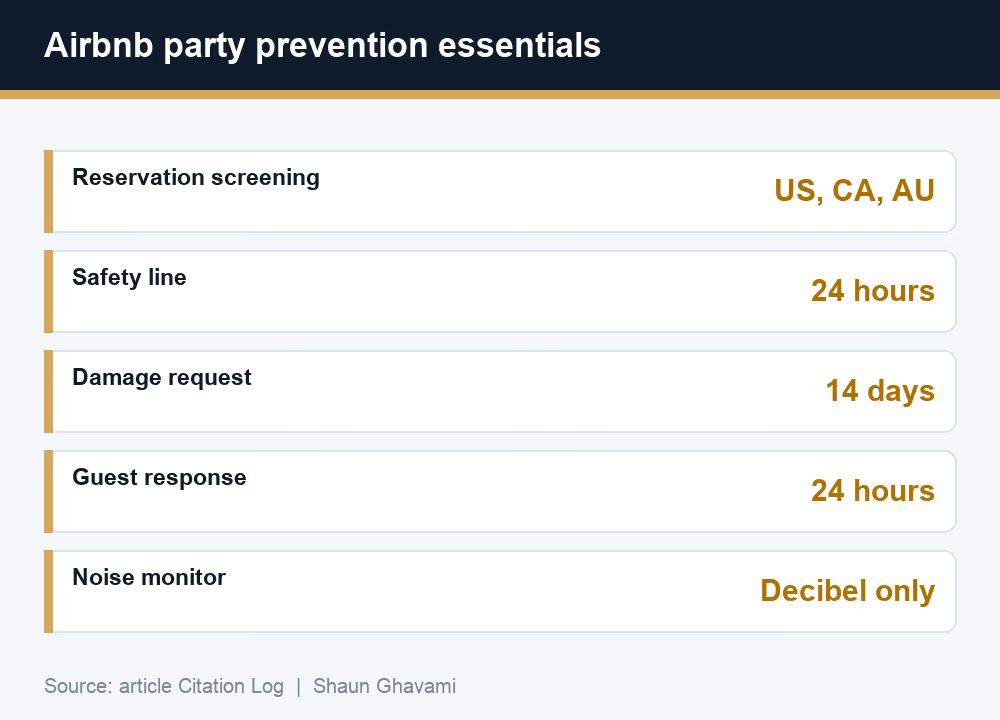
Some of the work is already done. Under AirCover for Hosts, Airbnb runs reservation screening, which uses machine learning to identify reservations at higher risk of a party or property damage incident. It is not everywhere: Airbnb lists it as currently available in the United States, Canada, and Australia, per Airbnb's AirCover for hosts page. Outside those markets, assume the filtering layer is not there and set your own rules harder.
AirCover also covers guest identity verification, which Airbnb requires for travelers to 35 countries, though a government ID is not collected in every case, plus a 24-hour safety line. None of it is a guarantee: screening cannot stop a verified guest with good reviews inviting forty people over on night two.
The prevention stack you control
This is where the actual work is. Each lever stops a different kind of booking.
| Lever | What it actually stops | Where you set it |
|---|---|---|
| Minimum stay of 2 or more nights | The single-night party booking | Availability settings |
| Booking requirements | Accounts with no verified ID or history | Booking settings |
| Same-day booking cut-off | The impulse "we need a place tonight" | Availability settings |
| Stated guest count | Ambiguity about headcount | Listing details, house rules |
| Written house rules | Arguments you cannot win later | House rules |
| Disclosed decibel monitor | Noise, before a neighbor calls | Listing description |
Minimum stays and same-day bookings
The single most effective setting is a two-night minimum, three on holiday weekends. Parties are usually a one-night purchase, and someone planning a Saturday blowout will not pay for Sunday too. Add a same-day booking cut-off, because the reservation made at 4pm for that evening is the highest-risk booking there is.
Booking requirements and instant booking
Airbnb lets you set requirements a guest must meet before booking. Every host, new co-host, and booking guest has to be identity verified to use Airbnb at all, and you can require prior positive reviews before instant booking is available. If a request comes from an account with no history, ask questions first. How I ask them, and where the line is, is in how to screen Airbnb guests.
House rules that survive an argument
Vague rules are unenforceable rules. "Be respectful" means nothing at 2am. Write the specific ones: quiet hours with actual times, the maximum guests including day visitors, whether visitors are allowed at all, no smoking anywhere, and a plain line that events and parties are not permitted. Then restate them in your pre-arrival message. The structure is in Airbnb house rules, and the message that repeats them is in my Airbnb guest communication templates.
Get the free Airbnb co-hosting training and I will show you how I protect other people's properties for a living.
Noise monitoring, done the legal way
A decibel monitor measures sound level and nothing else. It does not record audio or listen to conversations, which is the whole reason the category exists. You get an alert when volume crosses a threshold, which buys you one message before a neighbor calls the city.
Two rules I will not bend on. Disclose it: any monitoring device has to be disclosed in your listing before a guest books, and a guest who finds an undisclosed one has a legitimate complaint against you. And nothing indoors that records: cameras inside the home are off the table, monitors belong in shared living areas rather than bedrooms or bathrooms, and covert anything is a policy and a trust problem. Airbnb has tightened these rules more than once, so check the current camera and device policy before you install.
Exterior cameras follow the same logic: allowed in principle, must be disclosed, must not point where a guest expects privacy. A doorbell camera tells you how many people walked in, usually the only fact you need. Local rules can be stricter, so read short-term rental laws for your market.
The local-booking question, handled without discriminating
Hosts talk about local bookings as if they are automatically bad. They are not. People book in their own city for renovations, relocations, a hospital stay, a visiting family. The higher-risk pattern is narrow: a same-city account with no reviews booking a single weekend night at maximum guest count.
Handle that with rules that apply to everyone, not judgments about one person. The two-night minimum, same-day cut-off, and review requirement already filter that pattern out. If a local request still arrives, ask what you would ask anyone: what brings you to town, and how many people are staying.
Screening has to stay inside Airbnb's Nondiscrimination Policy. Screen on behavior and trip facts, verified ID, prior reviews, trip purpose, group size, agreement to the house rules. Never on race, color, ethnicity, national origin, religion, sex, gender identity, sexual orientation, disability, or any other protected class. "Local" is not a protected class, but the safe way to act on it is a setting that applies to every guest equally.
What to do when a party is happening right now
Do this in order, because the first four steps are also the evidence you will need afterwards.
- Message the guest on Airbnb. In writing, so it is timestamped. Short and factual: the noise level, the time, the rule, and what to do in the next 15 minutes.
- Call them. One clear instruction, one deadline. Do not negotiate house rules over the phone at midnight.
- Send your local contact, not yourself. A co-host, cleaner, or neighbor can assess from outside. Never confront a crowd alone.
- Call Airbnb. The 24-hour safety line under AirCover exists for this. Get it on record while it is happening.
- Call local police if there is a safety risk or the guests refuse. Use the non-emergency line unless someone is in danger, and ask for the report number.
- Document as it happens. Decibel alerts with timestamps, neighbor messages, the Airbnb thread, and photos taken after the guests leave, never during.
What not to do: cut the utilities, change the lock code while people are inside, or drive over angry. Any of those turns your guest's violation into a safety incident you own. The follow-up is in how to deal with bad Airbnb guests.
After checkout: reporting and recovering damage
Two separate jobs, and hosts often only do one. The first is reporting the violation so it lands on the guest's record. Enforcement only escalates if incidents are filed, and the host who says nothing is the reason the next host gets the same guest.
The second is money. Airbnb does not hold a traditional up-front cash deposit the way a lease does, so recovery runs through the Resolution Center. File the reimbursement request within 14 days of the guest's checkout. The guest then has 24 hours to respond. If you need Airbnb Support involved, submit supporting documentation within 14 days of the damage or loss, per Airbnb's Host damage protection page. How deposits actually work is covered in Airbnb security deposit.
Co-hosting: it is somebody else's asset
Managing for owners changes the stakes. A suspension costs the owner their income and, far enough down the ladder, their listing. That is why my party protocol is written into the agreement rather than assumed.
- Who calls the police, and when. Decide it in daylight, not at 1am.
- What you can spend without asking. A dollar limit for an emergency locksmith, a rekey, or an immediate repair.
- Which settings are locked. If an owner wants a one-night minimum and instant booking wide open in a party-prone market, that is their call, but document it.
Put those in the Airbnb co-hosting agreement alongside the payout terms. If you are still building the business itself, how to start an Airbnb business comes first, then set these levers before your first booking, not after your first incident.
Get the free Airbnb training and see how I built a management portfolio on other people's real estate.
Frequently asked questions
No. Airbnb's Community Disturbance Policy does not allow open-invite parties, disruptive gatherings, or other community disturbances during a reservation, and hosts cannot advertise a listing as party friendly. Enforcement runs from warnings to listing suspension or removal to account removal.
A minimum stay of two nights, three on holiday weekends, stops more parties than anything else, because most parties are a one-night booking. Pair it with a same-day booking cut-off and requirements that keep accounts with no history from instant booking.
Yes, if it measures sound levels only and you disclose it. Decibel monitors do not record audio or conversations, which is what makes them acceptable, and any monitoring device has to be disclosed before a guest books. Keep them out of bedrooms and bathrooms.
Yes, in some markets. Reservation screening under AirCover for Hosts uses machine learning to identify reservations at higher risk of a party or property damage incident, and Airbnb lists it as available in the United States, Canada, and Australia. It reduces risky bookings rather than eliminating them.
Message the guest on Airbnb first so the exchange is timestamped, then call with one instruction and a deadline. Send a local contact rather than going yourself, call Airbnb's 24-hour safety line, and involve police if there is a safety risk. Photograph the damage only after they leave.
File a reimbursement request in the Resolution Center within 14 days of the guest's checkout. The guest has 24 hours to respond, and if you need Airbnb Support involved you submit supporting documentation within 14 days of the damage or loss.
.png)

Be Part of our Community.
Let’s transform properties into powerhouses.
