
August 14, 2026
Is Airbnb Passive Income? An Honest Breakdown
By Shaun Ghavami

A self-managed Airbnb is not passive income. It is a small business attached to a physical building, and in my own operating experience one listing takes somewhere in the range of 13 to 28 hours a month once you add up guest messaging, turnovers and cleaner coordination, pricing updates, maintenance, restocking, and admin. Those hours are illustrative figures from the listings I run, not a survey result. You can cut that number hard with systems, and you can get it close to an hour a month by handing the listing to a co-host or manager, who typically charges an industry-typical 10% to 30% of booking revenue. Passive for the owner means somebody else is doing it actively.
I started with a $65-a-night spare bedroom and now manage a portfolio worth over $100 million for other owners, which is why I can be blunt about this. The owners I work with do get something close to passive income. I am the reason it is passive; the work did not evaporate, it moved. Below is what that work is in a month, what each piece costs to remove, and the honest version of what goes wrong.
The honest answer: a job you can shrink, not a job that disappears
"Passive" means income that arrives without you doing anything that month. By that definition an index fund is passive and a self-managed short-term rental is not. Somebody answers the 11pm message, chases the cleaner who did not show, and sets next weekend's rate.
Hosting income also scales with attention in a way most rental income does not. A long-term tenant signs a lease and you hear from them a few times a year. A short-term rental resets every few nights, and every reset is a new guest, a new price, a new turnover, and a new review. That churn is where the hours live.
The market backdrop rewards operators over absentee owners too. AirDNA's 2026 outlook projects US short-term rental supply growth of about 4.6%, well below the roughly 20% expansion of 2021 and 2022, with occupancy easing around 1% and average daily rates up about 1.5%, which the firm calls the best investing backdrop since 2021 (AirDNA, via PR Newswire). That is a market where the operator who prices well and turns over cleanly takes share. Whether the numbers work in your market is answered in is Airbnb still profitable.
Where the hours actually go in a month
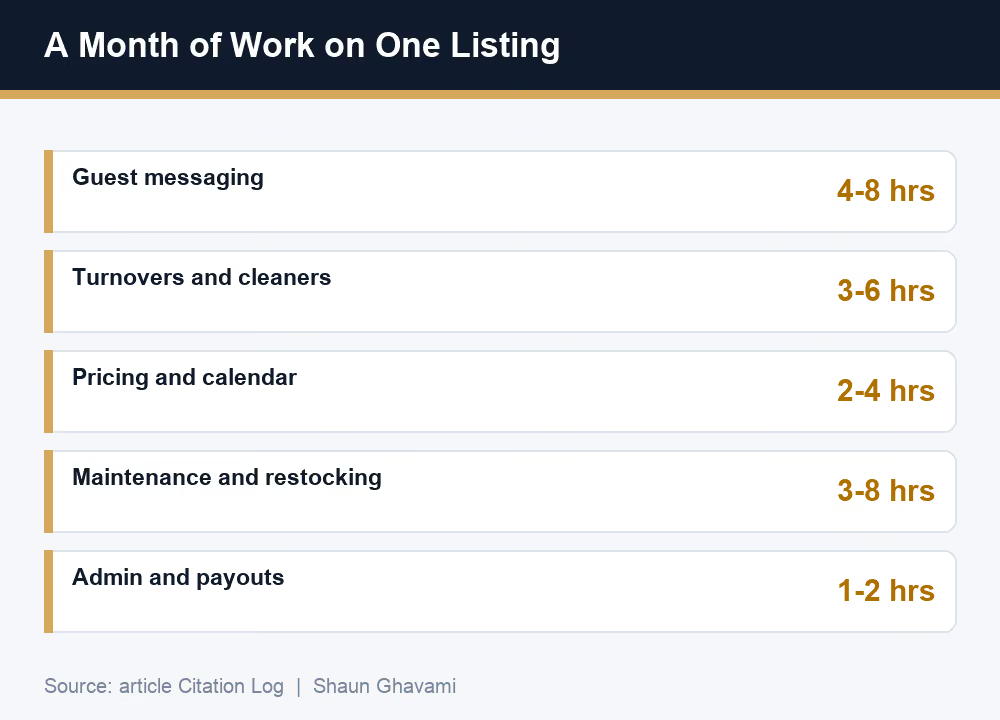
Here is the recurring work on one listing. The hour ranges are illustrative estimates from my own operating experience, not published data. A remote cabin with a hot tub sits at the top of every range, a downtown studio with a keypad near the bottom.
| Recurring work | What it actually involves | Illustrative hours per month |
|---|---|---|
| Guest messaging | Inquiries, pre-arrival, mid-stay problems, checkout, writing reviews | 4-8 |
| Turnovers and cleaner coordination | Scheduling each turn, confirming completion, covering a no-show | 3-6 |
| Pricing and calendar | Rate reviews, local events, filling orphan gaps, minimum-stay changes | 2-4 |
| Maintenance and repairs | The broken thing, finding and meeting a vendor, filters and batteries | 2-5 |
| Restocking and supplies | Consumables, linen replacement, the coffee machine that died | 1-3 |
| Admin | Payout checks, receipts, permit or license renewals, owner reporting | 1-2 |
Two of those lines are not optional. Host responsiveness is one of the host-controlled factors Airbnb names in how listings place in search, and price against comparable listings is another, both covered in how the Airbnb algorithm works. Ignore either and you lose bookings, not only hours.
The first three months run well above these ranges, because you are fixing things you did not know were broken and building every template from scratch. Budget for it separately from your startup spend, which I break down in how much it costs to start an Airbnb.
The automation ladder: what you can actually remove
Almost nothing on that list disappears. It either gets systematized (you still own it, it just takes less time) or handed to a person (someone else owns it, and you pay for that). Knowing which is which saves wasted software spend.
| The work | Systematize or hand off | What it costs you |
|---|---|---|
| Guest messaging | Mostly systematize: scheduled sequences and saved replies cover the routine 80% | A subscription, plus your time on the messages that are a real problem |
| Check-in questions | Systematize: a keypad or smart lock plus one clear arrival message | One-time hardware cost, then close to zero |
| Turnovers | Hand off: a cleaner with a fixed checklist and photo proof | Per-turn cost, usually covered by the cleaning fee you charge |
| Pricing | Systematize with review: a tool sets the baseline, you call events and gaps | Subscription, plus an hour or two of judgment a month |
| Maintenance | Hand off: a standing handyman and plumber who answer your calls | Hourly or per-job rates, and a retainer in busy markets |
| Restocking | Hand off: fold into the cleaner's scope with a standing supply order | A small uplift per turn on top of the cleaning rate |
| The whole listing | Hand off: a co-host or manager runs all of the above | Industry-typical 10% to 30% of booking revenue |
Start with the messaging rung. It is the highest hours-per-dollar win and it improves the guest experience: a sequence covering booking confirmation, pre-arrival, arrival day, mid-stay, and checkout, built as I lay out in Airbnb message automation.
Pricing is the rung people misjudge in the other direction. A tool gives you a baseline, but it does not know the marathon is in town or that a two-night gap needs a discount. Treat it as an assistant rather than an autopilot, using the method in how to price your Airbnb.
When it genuinely becomes close to passive
For the owner, the honest answer is: when a co-host or a property manager runs the listing. That is the only rung that removes the 11pm message, the no-show cleaner, and the Sunday plumbing call.
That costs an industry-typical 10% to 30% of booking revenue, a market range rather than a rate Airbnb sets. Roughly, 10% to 15% buys communication only, 15% to 20% buys day-to-day operations, and 20% to 30% buys full service. Around 20% is what I see most often for full-service work. Airbnb supports three payout structures and the split is set only by the listing owner: a percentage of each booking, a fixed amount per booking, or the cleaning fee. Specifics of each are in Airbnb co-host pay and fees.
An illustrative example, with the assumptions stated
These are assumed inputs showing the shape of the math. They are not a projection, a typical result, or a promise about what any listing earns.
ASSUMED INPUTS (illustrative only)
  Booking revenue for the month .................. $4,000
  Airbnb host service fee, split-fee model, ~3% ... $120
  Co-host at 20% of booking revenue .............. $800
  Owner's time before handing it off ............. ~15 hours
  Owner's time after ............................. ~1 hour

RESULT
  $4,000 - $120 - $800 = $3,080 before the owner's own
  costs (mortgage, utilities, supplies, insurance, and
  anything else specific to the property).

  Traded: $800 and about 14 hours of the owner's month.
Whether that trade is good depends on what an hour of your time is worth. For an owner with one listing and a demanding job, 20% is often the cheapest thing they buy all month. For an owner with time and a property nearby, keeping the $800 is rational. The fee above uses the split-fee model, where the guest pays roughly 14.1% to 16.5% of the booking subtotal and the host pays around 3%; some listings sit on a host-only fee model at around 15.5% (Airbnb service fees).
The flipside nobody puts on the sales page
Every "passive" Airbnb has an active person behind it, and that person gets paid.
Co-hosting is the active side of somebody else's passive income. You take on the messaging, the turnovers, the pricing, and the problems, and you are paid a share of the booking revenue. You buy no property and carry no mortgage, and your startup cost is your time plus a phone. What co-hosts charge is in how much Airbnb co-hosts make, and the path to doing it without owning anything is in how to start an Airbnb without owning property.
Be clear-eyed about the choice. Co-hosting is a service business, so it is the least passive version of this category on day one. It is also the version with the lowest capital requirement, and how I learned every operational lesson I later applied to a portfolio. Either way the underlying business is the same one, mapped end to end in how to start an Airbnb business.
What can go wrong, honestly
The failure modes are predictable, and most are avoidable if you plan for them.
- Your cleaner becomes a single point of failure. One cleaner, one phone number, and a same-day turn is a bad configuration. Have a backup before you need one.
- Seasonality hits the calendar, not the costs. Bookings drop in the shoulder season while the mortgage, utilities, and subscriptions do not.
- Local rules change under you. Permit caps, registration requirements, and building or HOA restrictions can change what you are allowed to run. Check before you buy or sign.
- Deferred maintenance arrives on a holiday weekend. Turnover volume wears a property faster than a long-term tenancy does, so budget for linen, mattress, and appliance replacement.
- You hand it off to the wrong person. A cheap manager who does not answer guests costs more in lost bookings and rating than the percentage saved. Check references first.
Maintenance is already on the list of monthly work above, and part of that is handling damage claims correctly when a guest causes more than normal wear.
Frequently asked questions
Not when you self-manage it. A self-managed listing is a small business with recurring guest messaging, turnovers, pricing decisions, maintenance, restocking, and admin every single month. It becomes close to passive for the owner only when a co-host or property manager takes that work on, which typically costs an industry-typical 10% to 30% of booking revenue.
In my own operating experience it lands in the range of 13 to 28 hours a month per listing, with guest messaging and turnover coordination the largest shares. Those are illustrative figures from the listings I manage rather than published data. A downtown studio with a keypad sits at the low end and a remote property with a hot tub sits at the high end.
Work the ladder in order: scheduled message sequences and saved replies first, then self check-in hardware, then a cleaner with a fixed checklist, then a pricing tool you still supervise, then standing maintenance vendors. The last rung is handing the listing to a co-host or manager, the only step that removes the late-night problems.
The industry-typical band is 10% to 30% of booking revenue, and it is a market range rather than a rate Airbnb sets. Roughly, 10% to 15% covers communication only, 15% to 20% covers day-to-day operations, and 20% to 30% covers full service. Airbnb supports a percentage of each booking, a fixed amount per booking, or the cleaning fee, and only the listing owner sets which applies.
Yes, by co-hosting, which means running listings that other people own in exchange for a share of the booking revenue. You take on the messaging, turnovers, and pricing, and you carry no mortgage. It is the least passive version of this business on day one and the one with the lowest capital requirement.
Turnover reliability, in my experience. One cleaner with no backup and a same-day changeover is the single most common way a good listing produces a bad review. After that it is seasonality, because bookings fall in the shoulder months while the mortgage, utilities, and subscriptions carry on.

.png)

Be Part of our Community.
Let’s transform properties into powerhouses.
