
August 14, 2026
How to Start an Airbnb Co-Hosting Business (Step by Step)
By Shaun Ghavami
.png)
To start an Airbnb co-hosting business, you set up as a service provider that manages short-term rentals for owners who keep the property, and you charge a cut of each booking in return. The industry-typical fee runs 10% to 30% of booking revenue, commonly around 20%, and Airbnb lets the owner set that payout as a percentage of each booking, a fixed amount per booking, or the cleaning fee. The build has six moves: choose your pricing model, register a business entity, sign a co-hosting agreement, stand up a tool stack to run listings remotely, land your first owner, then copy that system across a portfolio.
I run this exact model. I have managed a portfolio worth over $100 million for owners whose properties I do not own a single door of, hosted more than 3,000 guests, and earned Airbnb Superhost status along the way. What follows is the playbook I would hand a friend starting this week. No theory, just the steps and the real math behind them.
What an Airbnb co-hosting business actually is
A co-hosting business is a management company for other people's short-term rentals. The owner keeps the title, the mortgage, and the furniture. You run the day-to-day: pricing, guest messages, check-in, cleaning coordination, and reviews. In exchange you take an agreed slice of the revenue.
This is a different path from the two other ways into short-term rentals. You are not buying the property, and you are not signing a lease to sublet it the way rental arbitrage works. For the side-by-side, I break it down in co-listing versus rental arbitrage and in what Airbnb co-listing is. The short version: co-hosting is the lowest-capital way in, because your main investment is time and systems, not a down payment or a security deposit.
Airbnb builds this in. A single listing can carry up to 10 co-hosts, per the Airbnb Help Center, so an owner can bring you on without handing over their account. The platform then pays you directly based on the split the owner sets.
Step 1: Decide your commission and pricing model
Your pricing model is the engine of the business, so decide it first. Airbnb only lets the owner set the payout, and it can take one of three forms, per the Airbnb Help Center: a percentage of each booking, a fixed amount per booking, or the cleaning fee. You get paid after the guest checks in, by the end of the next business day.
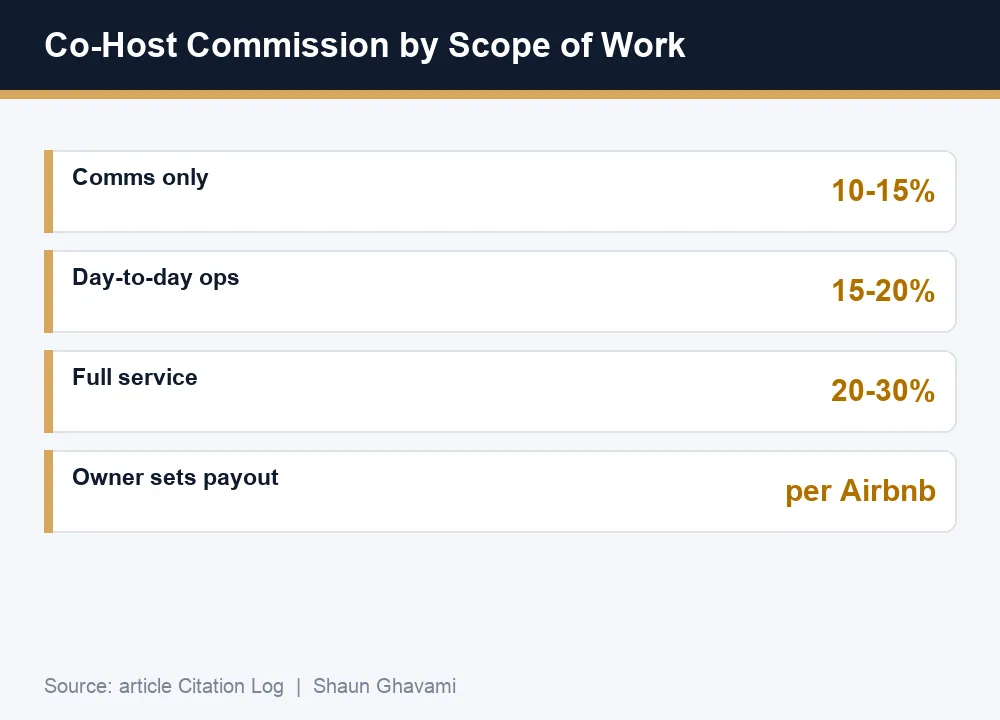
Most operators price on a percentage because it scales with the booking value. Where you land inside the band depends on how much work you take on. Here is the split I use as a starting point:
| Model | What you handle | Typical cut |
|---|---|---|
| Communication only | Guest messages and reviews | 10-15% |
| Day-to-day operations | Messages, calendar, cleaning coordination | 15-20% |
| Full service | Everything, including pricing and restocking | 20-30% |
This is an industry-typical band, not an Airbnb-set rate. You and the owner agree on it in writing. Around 20% is the common middle for a full-service arrangement. To sanity-check the take-home against real numbers, I go deeper in how much Airbnb co-hosts make and in how co-host pay and fees work.
Step 2: Register the business entity
You can co-host as a sole operator on day one, and many people do. Once you have a paying owner, most co-hosts form an LLC to separate personal money from business money and to hold the management contract in the company's name. It also gives you a clean business bank account for owner payouts and cleaner invoices. This is a general operating norm, not legal or tax advice, so confirm the right structure for your situation with a local accountant or attorney before you file.
Whatever you choose, open a dedicated business account before your first payout hits. Mixing owner money with your own is the fastest way to lose track of what you actually earned.
Step 3: Write a co-hosting agreement
Never manage a property on a handshake. The co-hosting agreement is the document that protects both sides, and it should spell out five things: your exact duties, your commission and how it is calculated, the Airbnb access level the owner grants you, the payment schedule, and how either party can end the arrangement.
Access level matters because Airbnb lets an owner grant full access, or narrower messaging-and-calendar access, or calendar-only. Match the permission to the duties in your contract so you are never blamed for something you were not allowed to touch. I put a full clause-by-clause walkthrough in the Airbnb co-hosting agreement guide, so use it before you sign anyone.
Step 4: Build your systems and tools stack
One property runs on effort. Five properties run on systems. Before you take a second client, put the operating stack in place so the work does not live in your head. You want a category for each job, and I keep the tool talk generic on purpose because the right pick changes by market:
- Dynamic pricing: software that adjusts nightly rates to demand instead of a flat price.
- Channel or property management: one dashboard for calendars, messages, and tasks across every listing.
- Guest messaging: automated check-in details, house rules, and review requests so nothing gets missed.
- Self check-in hardware: a smart lock, keypad, or lockbox so you are not driving to every door.
- Cleaning coordination: a shared calendar and turnover checklist your cleaners follow the same way each time.
- Bookkeeping: a simple system that tracks each owner's revenue, your cut, and the expenses.
The whole point of the stack is to run listings you never physically visit. I wrote a full field guide to that in how to manage an Airbnb remotely. Get this layer right and adding property number six feels the same as property number two.
Step 5: Get your first client
Your first owner is the hardest, and you almost never find them through a cold marketplace. Start with the properties already around you: a friend with a vacation condo they barely rent, a landlord whose unit is underperforming, a burned-out host tired of the messages. Lead with proof rather than promises and the pitch mostly makes itself. The full approach, including how to run a free audit and what to say, is in how to get Airbnb co-hosting clients.
Airbnb also runs a Co-Host Network that matches owners with local co-hosts, but it has a bar to clear: an active listing, a verified identity, at least 10 completed stays, a 4.8-or-higher rating, and a cancellation rate under 3%, as Hostfully notes. That is why I tell new co-hosts to host their own place, or a friend's, first. If you have not built that track record yet, start with how to become an Airbnb co-host, which covers the invite and eligibility path in detail.
Step 6: Scale from one property to a portfolio
Scaling is repetition, not reinvention. Once your systems run one listing cleanly, growth is a matter of copying the onboarding, the contract, and the tool stack onto the next owner, then hiring out the parts that eat your time, usually cleaning turnovers and guest messaging first.
Watch the market as you grow. AirDNA's 2026 outlook points to US short-term-rental supply growth cooling well below the boom-era pace, while demand holds steady and average daily rates edge up. Directionally, that means the land-grab days of easy new supply are over, and owners increasingly want an operator who can get more out of a listing they already have. That is exactly the co-host's job.
Here is the illustrative math on why a portfolio matters. Assume each property books $4,000 a month and you charge a 20% full-service fee. These are example inputs, not a promise:
| Properties under management | Monthly revenue each (assumed) | Your 20% cut | Your monthly income |
|---|---|---|---|
| 1 | $4,000 | 20% | $800 |
| 3 | $4,000 | 20% | $2,400 |
| 5 | $4,000 | 20% | $4,000 |
| 10 | $4,000 | 20% | $8,000 |
The jump from one to ten does not require ten times the effort once the systems carry the load. This whole approach folds into the bigger picture of building short-term-rental income without buying real estate, which I map out in the how to start an Airbnb business pillar guide.
This entire path assumes you never buy or lease anything yourself, and the broader case for getting started without owning property lays out why that is the safer first move.
Even at near-zero startup cost, it helps to see the full picture, so compare against how much it costs to start an Airbnb business across all three paths.
Frequently asked questions
It depends on your commission and how many properties you manage. Co-hosts commonly charge 10% to 30% of booking revenue, around 20% for full service. On a listing that books $4,000 a month, a 20% fee is $800 a month from that one property, so income scales with the size of your portfolio.
No, you can start as a sole operator, but many co-hosts form an LLC once they have paying owners to separate personal and business finances and to hold the management contract. This is a common operating choice, not legal advice, so confirm the right structure with a local accountant or attorney.
The listing owner sets the payout, which can be a percentage of each booking, a fixed amount per booking, or the cleaning fee. Airbnb pays the co-host after the guest checks in, by the end of the business day following check-in.
No. Co-hosting means managing rentals that other people own, so you never buy a property or sign a lease. Your investment is your time, your systems, and the track record that convinces owners to hire you.
A single Airbnb listing can have up to 10 co-hosts. That lets an owner bring on help without giving away their account, and it lets a co-hosting business share duties across a team as it grows.
Start with owners already in your network: friends with under-used vacation homes, landlords with soft-performing units, or hosts tired of the daily work. Lead with proof such as Superhost status and real reviews, and offer to take the operational load off their hands for an agreed cut.

.png)

Be Part of our Community.
Let’s transform properties into powerhouses.
