
August 5, 2026
How to Manage an Airbnb Remotely Without Living There
By Shaun Ghavami
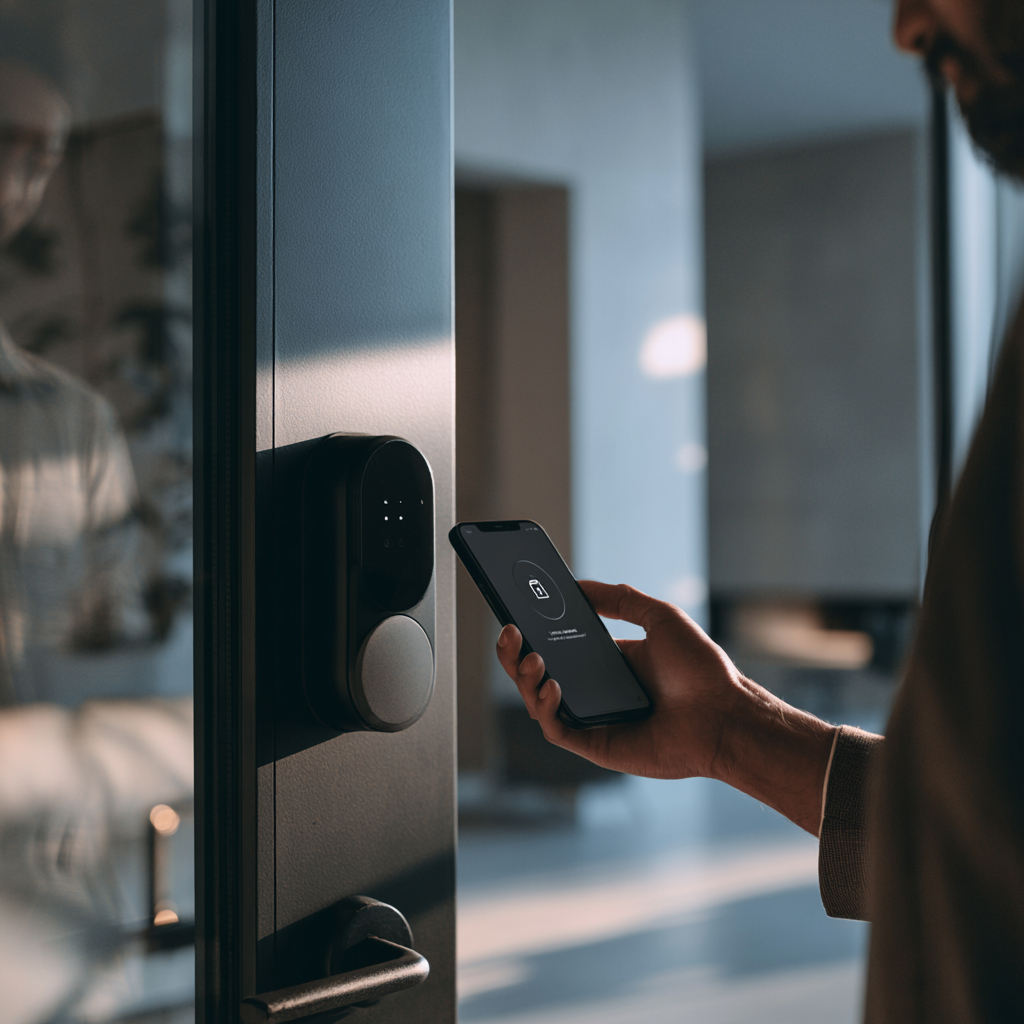
To manage an Airbnb remotely, you replace your physical presence with three things: a local ground team that can reach the property within an hour, smart access so guests let themselves in without a key, and systems that run pricing, messaging, and calendars on autopilot. Set those up and the house works whether you are across town or across an ocean. I have managed a portfolio worth over $100 million for owners who rarely, if ever, see their own units, and none of it depends on me standing in the doorway.
The short version: hire the right cleaner first, put a smart lock on the door, sync your calendars, automate your messages, and write one emergency page a stranger could follow. Do that and living somewhere else stops being a problem. This guide walks each piece in the order I actually set them up.
What remote management actually replaces
Managing remotely is a swap. On-site, you are the person who hands over keys, meets the cleaner, and picks up the phone when the heat quits. Remote, every one of those jobs still has to happen, it just happens through a person or a device you set up in advance.
Get specific before you buy anything. There are six jobs to cover: guest access, turnovers, maintenance, guest questions, pricing, and the rare 2 a.m. emergency. Each one needs an owner. Sometimes that owner is a smart lock. Sometimes it is a cleaner two blocks away. Your real job becomes hiring, checking, and paying the people and tools that cover those six jobs. If you have not built the underlying business yet, start with how to start an Airbnb business and how to run an Airbnb business, then come back and make it remote. This page is the "run it without living there" layer on top of those.
Build a local ground team before you leave
No device fixes a burst pipe. Your first hire, before any gadget, is a cleaner you trust, because the cleaner is also your eyes. A good one texts you a photo when a guest burns the counter or the shower starts draining slow. Pay for that relationship.
Aim for three local contacts:
- A cleaner who runs turnovers and flags damage. Give them a checklist and a supply closet with a code.
- A handyman for the small stuff: a jammed lock, a broken blind, a running toilet.
- One on-call vendor per system that can strand a guest: plumbing, HVAC, and the internet provider's support line saved in your phone.
Pay a little above local rate and treat these people like partners, not gig labor. AirDNA makes the same point in its 11 tips for managing an Airbnb remotely: the local team is what lets you run the place from anywhere. I pay my cleaners promptly, tip for the ugly jobs, and give them a direct line to me. In five years that has bought me more sleep than any app. The turnover standard I hold them to is in how to clean an Airbnb.
Wire the place for self check-in and remote control
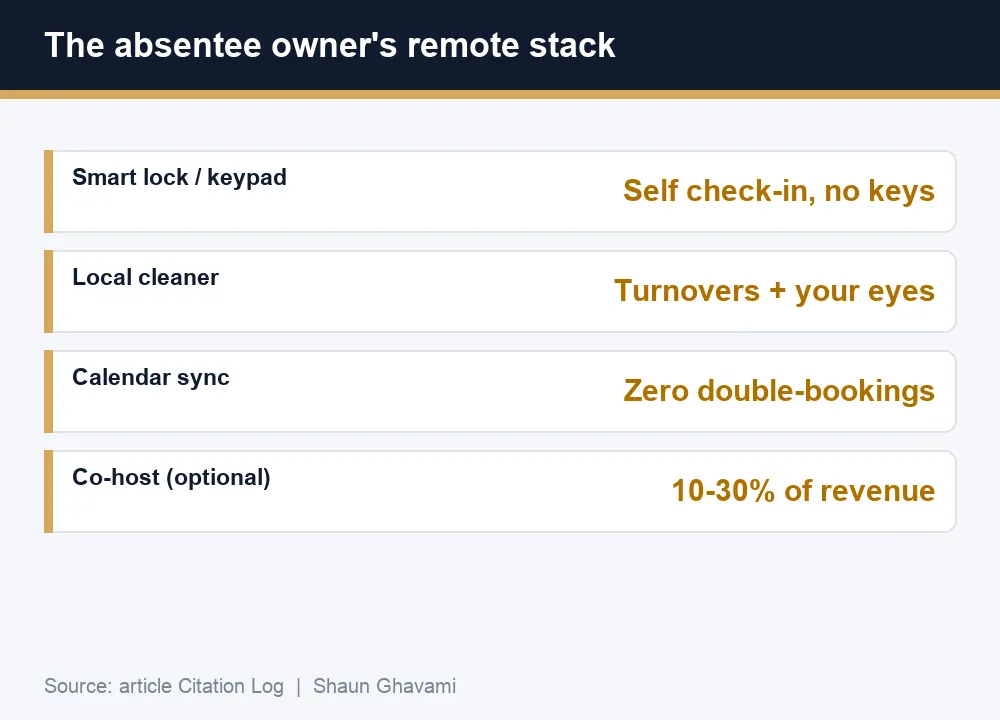
Once the people are in place, remove yourself from the doorway. Airbnb lets hosts offer self check-in through a smart lock, a keypad, a lockbox, or a key handoff, and the check-in instructions are shared with the guest before arrival, per Airbnb's self check-in help. A smart lock or keypad is the version I recommend for absentee owners, because you can issue a fresh code per guest and kill it at checkout without anyone driving over.
Then add the controls that save money and head off complaints:
- A smart thermostat so you can set limits and reset it between stays. No more guests running the AC at 62 with the windows open.
- A couple of smart bulbs or plugs for exterior and entry lighting, on a schedule, so no arrival lands in the dark.
- A wifi noise monitor (decibel only, never cameras indoors) for party detection in markets where that matters.
Every device you add is one less reason you personally have to be there. Configure each one once, label it in the app, and write down how it resets.
Get the free Airbnb co-hosting training and I will walk you through the setup end to end.
The systems that run without you
People and hardware cover the property. Software covers the guest. Three systems do most of the work.
1. Calendar sync
If you list on more than one platform, connect the calendars so a booking on one blocks those dates on the other. A double-booking is the fastest way to lose Superhost status and eat a cancellation, so this is not optional.
2. Automated messaging
Set up scheduled messages for the booking confirmation, the check-in instructions the morning of arrival, a mid-stay check, and the checkout steps. Hospitable's guide on managing Airbnb remotely treats guest messaging as the single biggest time sink you can automate, and I agree. My full method is in Airbnb message automation.
3. The emergency one-pager
This is the piece most owners skip. Write one page a stranger could act on: the wifi name and password, the breaker box location, the water shutoff, your three vendors with numbers, and a spend limit that reads "fix anything under $150 without calling me, call above that." Share it with your cleaner and, later, your co-host. It turns a midnight problem into a two-text problem.
Keep pricing on autopilot too, but check it. Dynamic pricing tools are fine, still glance at them weekly against your own market. Pull your market's real occupancy instead of trusting a national average. A healthy short-term rental often runs roughly 50% to 70% occupancy depending on the market and season, which is a rule of thumb, not a promise.
Stay DIY or hire a co-host? Run the number
There is a point where doing it all yourself costs more than it saves. Here is the math I use, with an example and assumed inputs.
Worked example (assumed inputs):
- The unit books 18 nights a month at $150 a night, so about $2,700 in revenue.
- A full-service co-host at 20% of revenue would cost $540 that month.
- If turnovers, messages, and vendor calls eat 15 to 20 hours you would rather spend elsewhere, you are effectively paying yourself $27 to $36 an hour to keep control (that is $540 spread across 15 to 20 hours).
If your time is worth more than that, or you travel, work full-time, or own in another city, a co-host usually wins. If you enjoy the work and the numbers are tight, stay DIY a while longer. The commission itself is an industry-typical band of 10% to 30% of booking revenue, commonly around 20%, agreed between you and the co-host, not set by Airbnb. Scope drives the number: 10% to 15% for messaging only, 15% to 20% for day-to-day operations, 20% to 30% for full service. How much Airbnb co-hosts make breaks the ranges down further.
| Job | Fully DIY (remote) | With a co-host |
|---|---|---|
| Guest messaging | You automate and monitor | Co-host owns it |
| Turnovers | You schedule the cleaner | Co-host schedules and inspects |
| Maintenance calls | Your vendors, your phone | Co-host's vendors |
| Pricing | You set and review weekly | Co-host manages |
| 2 a.m. emergencies | Your phone rings | Co-host's phone rings |
| Cost | Your time | 10% to 30% of revenue |
The absentee-owner to co-host handoff
This is the move most owners reach eventually, and it is the whole reason my business exists. You own the asset, someone else runs the day-to-day. The handoff is not "hand over the keys and hope." Do it in order.
- Document first. The emergency one-pager, vendor list, smart-lock access, and cleaning standards you already built become the co-host's operating manual. If you set up the systems above, this part is done.
- Put the split in writing. A short agreement covers the commission, who pays for supplies and repairs, spend limits, and how either side exits. I keep a template in the Airbnb co-hosting agreement guide.
- Add them correctly on Airbnb. The listing owner sets the co-host's payout, a percentage per booking, a fixed amount, or the cleaning fee, and the co-host is paid after the guest checks in, per Airbnb's co-host policy. A single listing can carry up to 10 co-hosts if you want to split roles.
- Start with a trial month. Watch the reviews and response time before you hand over everything.
If you do not own a property at all yet, the co-host path runs the other direction: you manage someone else's place for a cut of revenue. That is exactly the wedge in how to start an Airbnb without owning property and how to start an Airbnb co-hosting business, and it is how I built income before I owned much of anything. If you want to be the co-host other owners hire, how to become an Airbnb co-host is the place to begin.
Get the free Airbnb co-hosting training and copy the systems I use across a $100M-plus portfolio.
Frequently asked questions
Yes. Thousands of hosts run units in other cities and countries. The requirements are a local cleaner and handyman, smart or keypad access so guests self check in, and automated messaging and calendars. I manage properties for owners who almost never see their own units.
Hire a trustworthy local cleaner before anything else. The cleaner handles turnovers and acts as your eyes on the property, flagging the damage or maintenance you cannot see. Hardware and software come second.
Airbnb supports self check-in through a smart lock, keypad, lockbox, or key handoff, and the instructions are sent to the guest before arrival. A smart lock or keypad is best for absentee owners because you can set a unique code per guest and remove it at checkout.
Hire a co-host when the hours you spend on turnovers, messages, and vendor calls are worth more to you elsewhere, or when you travel or own in another city. Co-hosts typically charge an industry-standard 10% to 30% of revenue, commonly around 20%, agreed with you rather than set by Airbnb.
It is a single page a stranger could act on: wifi details, breaker and water shutoff locations, your vendor phone numbers, and a spend limit for repairs. It lets your cleaner or co-host solve a midnight problem without waking you, and it is the document most remote owners forget to write.
Document your systems, put the commission split and spend limits in a written agreement, then add the co-host on Airbnb where you as owner set their payout. The co-host is paid after the guest checks in. Start with a trial month before handing over everything.

.png)

Be Part of our Community.
Let’s transform properties into powerhouses.
