
July 20, 2026
How to Get Airbnb Co-Hosting Clients (With No Track Record)
By Shaun Ghavami
.avif)
To get your first Airbnb co-hosting clients, go straight to owners who already have a problem you can fix: underperforming listings, absentee owners, and hosts who are worn out by guest messages and turnovers. You find them in your own network first, then in local landlord and short-term rental Facebook groups, on Airbnb itself (the thin, low-review listings in your city), and through real estate agents and property owners who would rather not self-manage. You land them by leading with their problem instead of yourself, and by offering a low-risk trial on the first listing so a zero-review track record stops being the reason they say no.
I built my whole business this way. I have managed a portfolio worth over $100 million for owners who kept their own names on the deeds, and I never owned those properties. I started with one $65-a-night spare bedroom. You do not need to own real estate to get paid to run it well. You need owners who trust you with their asset and their income, and a first client who becomes your case study. If you are still deciding whether the role fits, read how to become an Airbnb co-host first, then come back for the client-getting part, where most new co-hosts get stuck.
Start with the owners already in your reach
Your first client is almost never a stranger. It is usually someone a connection or two away who already owns a place and is quietly frustrated with it. Before you post an ad, write down everyone you know who owns a second home, a condo they could not sell, an inherited property, or a rental they run themselves and complain about.
Then make a plain, human offer, not a sales pitch: I run Airbnb listings for owners now, handling pricing, guests, and turnovers. Want me to look at yours and tell you what I would change? That message has started more of my relationships than any ad. People trust someone they already know before a stranger with a five-star badge.
Before you talk to an owner, my breakdown of what Airbnb co-listing is helps you describe the arrangement in one clear sentence.
Where to find owners who actually need help
Once your own circle is tapped, go where owners cluster and struggle in public. The table below is the set of channels I would work first, in order, with the move that opens the door.
Where to lookWho you will findYour first moveYour own networkFriends and family with a second home, a condo, or a self-managed rentalA direct, plain message offering to review their listing for freeLocal landlord and short-term rental Facebook groupsOwners asking about cleaners, pricing, permits, and whether hosting is worth itAnswer their question helpfully in public, then offer a private listing reviewAirbnb search in your cityListings with weak photos, thin descriptions, and very few reviewsFind the host off-platform, then offer a specific fix, not a generic pitchReal estate agents and brokersBuyers who purchased as an investment and do not want to self-manageOffer a done-for-you option they can hand to clients, plus a referral thank-youYour first happy ownerOther owners in that person's circleAsk for one warm introduction once you have a result to show
The Airbnb-search channel is the one most new co-hosts miss. Open Airbnb in your market, filter for entire places, and scroll for listings clearly leaving money on the table: three dark photos, a one-line description, a calendar wide open in peak season. Those owners prove the demand exists and the execution does not. You are not cold-pitching a happy Superhost; you are fixing a leak the owner can already feel.
How to pitch owners: lead with their problem
New co-hosts want to talk about themselves to make up for no reviews. Do the opposite. In the first conversation, owners care about three pains: the listing sits empty too often, guests create headaches, and the whole thing eats hours they wanted back.
So open on the pain and be specific. If you found them through Airbnb, tell them what you noticed: weak photos hurting conversion, a minimum-night rule blocking weekend demand, or open nights next month that comparable listings have already booked. Name the problem before you name your fee and you stop being a salesperson and start being the person who understands their listing better than they do.
Keep the offer concrete. You handle pricing, guest messaging, and turnovers, you reply fast so reviews stay high, and you free up the owner's evenings. To sound like an operator rather than a hobbyist, get fluent in the day-to-day of running an Airbnb business before the call.
Chasing owners only pays off if the model itself holds up, and I put that to the test in whether co-hosting actually pays.
Want the exact system I use to run listings for owners?
Get the free Airbnb co-hosting training and see how the business works end to end before you take your first client.
.
What to show when you have zero reviews
No track record is a real objection, so meet it head-on with proof and risk reversal instead of hype.
Build a one-page proposal
Owners do not want a fifty-slide deck. Bring one page: the three specific problems you spotted, what you would change in the first thirty days, how you get paid, and a clear line that the owner keeps full control of the account and payout. That last part matters, because Airbnb lets an owner add a co-host to their existing listing and set the payout themselves, so nothing about their ownership changes. Point them to the Airbnb Help Center to confirm the owner, not the co-host, controls how the co-host is paid.
Reverse the risk with a trial
The fastest way past no reviews is to make the first deal nearly risk-free. Offer a trial: run the listing at a lower cut for the first sixty to ninety days, then move to your standard rate once results are in. You trade a little margin now for a case study, a testimonial, and referrals later. I would rather earn less on my first listing and own a real before-and-after than hold out for full price and stay at zero clients.
Owners will ask how you differ from a management company, and my answer to that is in how co-hosting differs from property management.
Borrow proof you can actually earn
You can also build credibility on the listings you take on. Run them well and you can qualify as a Superhost, a proof point for the next owner. The Airbnb Help Center spells out the bar: a 4.8-plus rating, at least ten reservations (or three totaling 100 nights), a 90% response rate, and under 1% cancellations over the trailing year.
How to price your first offer
Co-host pay is a share of booking revenue the owner and co-host agree on. Airbnb sets no rate; the owner controls the payout. The industry-typical band runs from about 10% to 30%, depending on how much you do.
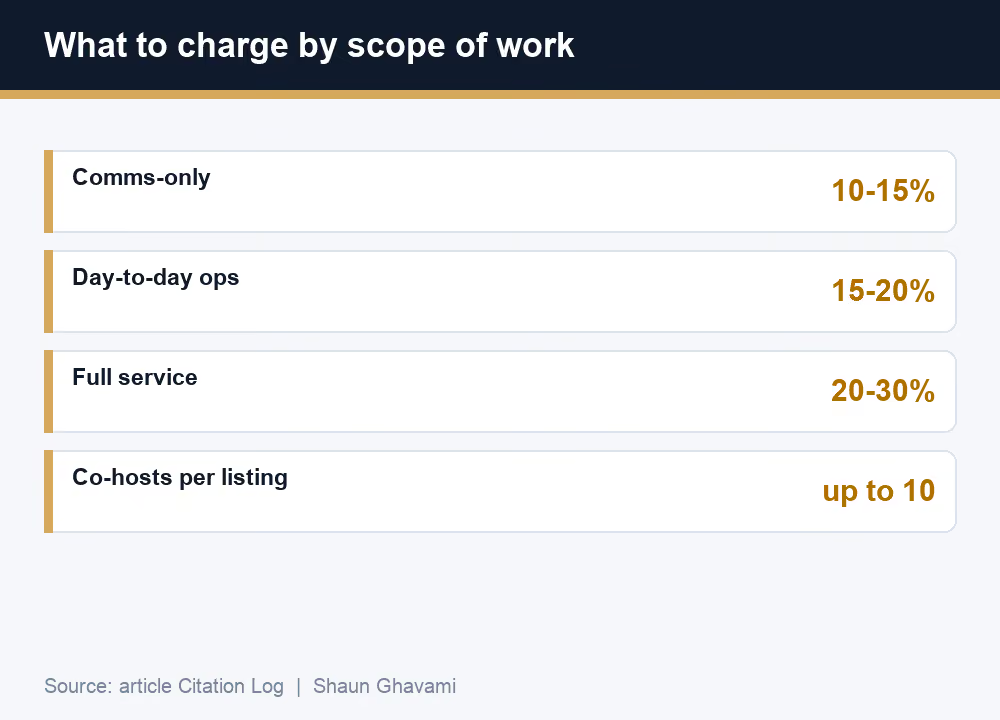
The tiers above map to scope: comms-only sits at the low end, day-to-day operations in the middle, and full service (pricing, guests, and turnovers) at the top. With no reviews, quote the low end of your tier for the trial, then step up once you have proof.
Now a worked example, with clearly illustrative numbers so you can see the shape of the deal (your market will differ). Say one listing books $4,000 in a month. At a 20% full-service fee the owner agrees to, you earn $800 that month from that one listing, and five similar listings would be $4,000 a month from properties you do not own. One caveat for your agreement: Airbnb takes its own service fee out of the payout, about 3% on the host side under the split-fee model, per the Airbnb Help Center. Decide up front whether your percentage is on the booking subtotal or the net payout, and put it in writing.
Winning an owner and then losing them is its own failure mode, and I covered it in common Airbnb co-hosting mistakes.
I am keeping the money math light on purpose. For the full breakdown, see how much Airbnb co-hosts make and the mechanics in Airbnb co-host pay and fees. Whatever you agree, get it on paper with a simple Airbnb co-hosting agreement so the split, scope, and exit are clear from day one.
Turn your first owner into a referral machine
The first client is the hard one. After that, the cheapest client you will ever get is a referral from an owner you already made money for, so engineer it.
Deliver a result you can point to: more booked nights, a higher rating, fewer headaches. Keep the owner informed with one short monthly update showing revenue and occupancy. An owner who gets a clean monthly number becomes your best salesperson without being asked.
Then ask right after you send a strong month, not at signing: if you know another owner who wants this handled, I have room for one more listing this quarter. Reward it with a small thank-you or a credit on the referring owner's fee, and goodwill becomes a habit. This is how a single spare-bedroom start becomes a portfolio, and my guide on how to start an Airbnb business shows where co-hosting fits the bigger plan.
Ready to land your first owner?
The free Airbnb training walks through pitching owners, pricing your offer, and running the listing so you keep the client.
.
Frequently asked questions
How do I get Airbnb co-hosting clients with no experience or reviews?Start inside your own network, then find owners with weak or under-booked listings on Airbnb and in local short-term rental Facebook groups. Lead with the specific problem you spotted, not your background, and reverse the risk by offering a lower cut for a sixty to ninety day trial. One strong result becomes the case study that lands the next client.
Where do I find property owners who need a co-host?The best channels are your own circle of people who own a second home or self-managed rental, local landlord and short-term rental Facebook groups, and Airbnb itself, where you can spot listings with poor photos, thin descriptions, and open calendars. Real estate agents are strong too, since their investor clients often do not want to self-manage. Work them roughly in that order.
What should I charge my first co-hosting client?Co-host pay is a share of booking revenue that the owner sets, and the industry-typical band runs from about 10% to 30% depending on scope. As a new co-host, quote the low end of your tier during a trial period, then raise it once you have results and reviews. Put the exact split and scope in a written co-hosting agreement.
How do I pitch an owner whose listing is underperforming?Open on their problem in concrete terms: weak photos hurting conversion, a minimum-night rule blocking weekend demand, or open nights that comparable listings have already booked. Then offer a clear fix and explain that they keep full control of their account and payout. Naming the leak before naming your fee makes you the expert, not the salesperson.
Do I need a license to be an Airbnb co-host?It depends entirely on your city, since short-term rental rules are set locally and vary widely. Some markets require the owner to hold a permit while the co-host simply operates the listing, and others have stricter registration rules. Check your local requirements before you take a client, starting with my overview of short-term rental laws.
How many co-hosting clients can I take on?From the operator side there is no hard cap on how many listings you manage, so you can scale as your systems allow. On any single listing, Airbnb allows up to ten co-hosts, which is useful if you build a small team. Start with one or two listings, prove your process, then add more as referrals come in.

.png)

Be Part of our Community.
Let’s transform properties into powerhouses.
