
July 20, 2026
Is Airbnb Co-Hosting Worth It? An Honest Look at the Money and the Work
By Shaun Ghavami

Is Airbnb co-hosting worth it? For the right person, yes. Co-hosting is worth it if you want short-term rental income without buying property or locking up capital, you are organized, and you can serve a market with real booking demand. You run someone else's listing for a share of the revenue, usually 10% to 30%. It stops being worth it if you expect fully passive income or you dislike talking to guests, because the pay follows the effort. Treat it as a real side hustle with real hours, not a set-and-forget check.
I am Shaun Ghavami. I co-founded 10XBNB and run Iconic Retreats in Vancouver, and I have managed a portfolio worth over $100 million for other owners without owning those units myself. I started with a single $65-a-night spare bedroom. So when I say co-hosting can pay well, I also mean it asks for organization, fast replies, and a stomach for the odd 11 p.m. message. Here is the honest breakdown so you can decide.
The short answer: who co-hosting is worth it for
Co-hosting is a service business. You do the day-to-day work of running a listing (pricing, guest messages, cleaner coordination, problem-solving) and the owner pays you a cut. That model is worth it for a specific kind of person and a waste of time for another.
It is worth it if you are:
It is not worth it if you:
The upside that makes it worth it
Three things make co-hosting one of the better ways into short-term rentals. If you have read what Airbnb co-listing is, this will sound familiar.
Low capital to start
You do not buy the property, furnish it, or sign the lease. The owner already carries that cost and risk. Your startup cost is close to your time plus a little software. That is the whole reason co-hosting exists as a path for people who want the income without owning the asset.
You earn a percentage of real revenue
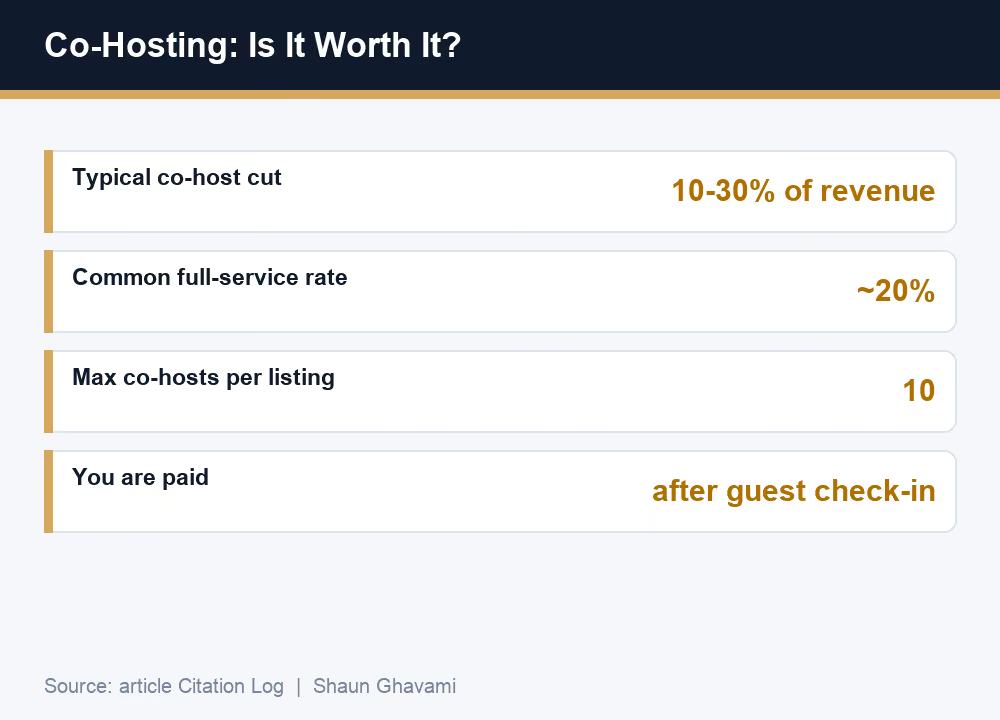
Co-hosts are commonly paid 10% to 30% of booking revenue, with roughly 20% typical for full day-to-day management. That band is industry-typical, not a rate Airbnb sets. The listing owner sets your payout, and it can be a percentage per booking, a flat amount per booking, or the cleaning fee, per the Airbnb Help Center. For how the numbers actually shake out, see how much Airbnb co-hosts make and the breakdown of co-host pay and fees.
It scales by adding doors
One good listing is a side income. Five or ten is a business. A single listing can have up to 10 co-hosts, and there is nothing stopping you from managing several owners' listings at once, per Airbnb's Help Center. Your income grows by signing more owners, not by buying more real estate.
If the return looks worth it to you, the next practical step is filling your roster, and I cover that in attracting co-hosting clients.
Want the full playbook?I put my co-hosting system into a free class: how to land owners, price the deal, and run the day-to-day. Get the free Airbnb co-hosting training.
The real costs and time it takes
Here is the part most "is it worth it" articles skip. The percentage you earn is gross, not take-home, and the work is real.
Is the math worth it? A worked example
Numbers make "worth it" concrete. The table below uses illustrative example inputs, not a guarantee or an average. Your real numbers depend on your market, the listing, and the rate you agree with the owner.
Illustrative inputValueOne listing books per month (gross revenue)$4,000Your agreed co-host share20%Your fee from one listing (before your own costs)$800Two listings at the same rate$1,600Three listings at the same rate$2,400
Part of judging the value is knowing the alternative, and I set them against each other in property management vs Airbnb co-hosting.
So one listing is a modest side hustle, and a handful starts to look like a real income. That is the honest shape of it: the ceiling is high because you can add owners, but every dollar above is still gross, and you earn it by doing the work. Define in writing which number your percentage applies to (booking subtotal, payout, or total) so there are no surprises.
Is Airbnb co-hosting a good side hustle?
Yes, for an organized operator it is one of the better side hustles in short-term rentals, because your downside is capped (you are not on the hook for a mortgage) and your upside scales with effort. The demand backdrop helps too. Per AirDNA, US short-term rental supply growth has cooled while demand has held steady into 2026, which is a healthier setup for operators than the flood of new listings a few years ago. Use that directionally, then pull your own market's numbers before you commit.
If you are weighing co-hosting against renting a unit yourself and subletting it on Airbnb, read co-listing vs rental arbitrage. Co-hosting keeps your cash risk near zero, while arbitrage puts you on the lease. Different risk, different reward.
Most people who conclude it was not worth it made one of the errors in Airbnb co-hosting pitfalls.
Who should skip co-hosting
Be honest with yourself before you start. Skip it if you want money without involvement, because there is no such version of this. Skip it if you will not answer a guest within a few hours, because response speed is the whole game. And skip it, at least for now, if your local market has weak booking demand, because a fair percentage of a small number is still a small number. In a thin market you are better off learning the model first, then serving a stronger one remotely.
How to decide if it is worth it for you
Run this quick test. Do you have a market with real bookings? Can you reply fast and stay organized? Are you willing to prospect for owners? If you answered yes three times, co-hosting is very likely worth it for you. If you flinched at the guest-communication or the sales part, fix that first.
When you are ready, the path is straightforward: learn the model, land your first owner, and run one listing cleanly before you add more. Start with how to become an Airbnb co-host for the step-by-step, and use the pillar guide on how to start an Airbnb business to see where co-hosting fits in the bigger picture. If you want to sanity-check the money side, whether Airbnb is still profitable covers the current demand picture.
Ready to run the numbers on your own market?My free training walks through landing owners, setting your rate, and building a co-hosting income without owning property. Get the free Airbnb training.
If the math and the lifestyle both check out, the full build from first client to a real operation is in how to start an Airbnb co-hosting business.
Frequently asked questions
Is Airbnb co-hosting worth it in 2026?Yes, if you want short-term rental income without owning property and you are willing to do the guest communication and owner outreach. You earn a share of booking revenue, commonly 10% to 30%, so a single listing is a side income and several listings can become a real business. It is not worth it if you expect fully passive money.
Is co-hosting a good side hustle for beginners?It is one of the better short-term rental side hustles because your startup cost is close to zero, you do not sign a lease or buy a property, and you can add owners as you learn. The tradeoff is that it is active work, so it suits organized, responsive people. Start with one listing and build a system before you scale.
How much do Airbnb co-hosts actually make?Pay is commonly 10% to 30% of booking revenue, with roughly 20% typical for full day-to-day management. The listing owner sets your payout, which can be a percentage, a flat fee per booking, or the cleaning fee. Your actual dollars depend on your market, the listing's revenue, and how many listings you run.
Is Airbnb co-hosting passive income?No, it is active income. Co-hosts handle guest messages, coordinate cleaners, solve problems, and find owners. You can build systems and a team so it takes less of your personal time, but someone always has to run the day-to-day. Treat it as a business, not a passive check.
Do I need to own property to co-host?No. That is the whole point of co-hosting. You manage someone else's listing for a share of the revenue, so you get short-term rental income without the capital, the lease, or the ownership risk. It is the main way people earn from Airbnb without owning the property.
Who decides how much a co-host is paid?The listing owner sets the co-host payout in Airbnb, and it can be a percentage per booking, a fixed amount per booking, or the cleaning fee. You and the owner agree on the rate and scope up front, ideally in writing. The co-host is paid after the guest checks in.

.png)

Be Part of our Community.
Let’s transform properties into powerhouses.
